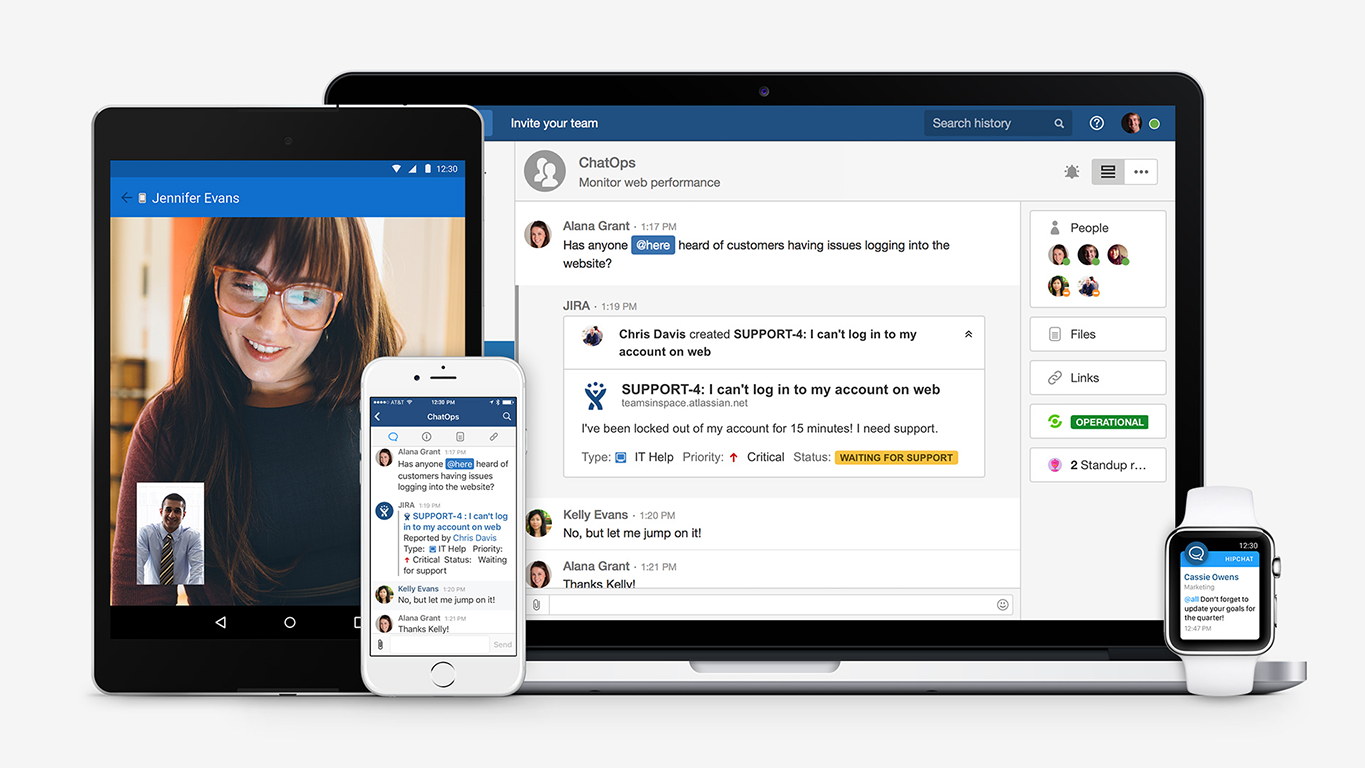
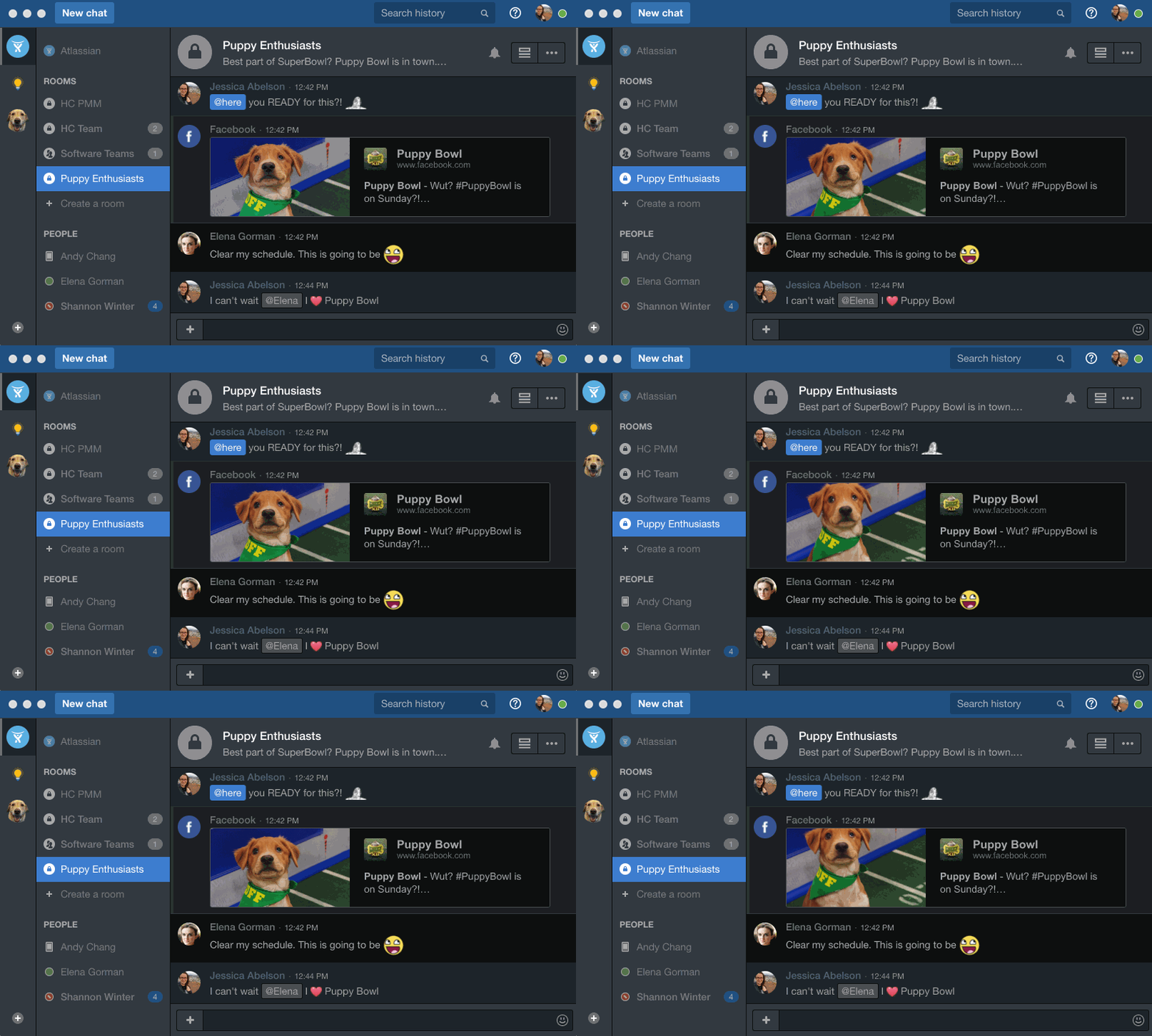
Hipchat was discontinued by Atlassian. Users are being migrated to Slack.
$0
per user
Miro
Score 9.2 out of 10
N/A
Miro empowers cross-functional teams to flow from early discovery through final delivery on a shared, AI-first canvas. With the canvas as the prompt, Miro’s AI capabilities keep teams in the flow of work, and scale shifts in ways of working.
$0
Pricing
HipChat (discontinued)
Miro
Editions & Modules
HipChat Basic
$0
per user
HipChat Plus
$2
per user
1. Free - To discover what Miro can do. Always free
$0
2. Starter - Unlimited and private boards with essential features
$8
per month (billed annually) per user
3. Business - Scales collaboration with advanced features and security
$16
per month (billed annually) per user
4. Enterprise - For work across the entire organization, with support, security and control, to scale
contact sales
annual billing per user
Offerings
Pricing Offerings
HipChat (discontinued)
Miro
Free Trial
Yes
Yes
Free/Freemium Version
Yes
Yes
Premium Consulting/Integration Services
No
No
Entry-level Setup Fee
No setup fee
Optional
Additional Details
For Server pricing info please visit https://www.hipchat.com/server (Only $1.20/user/month at the highest user tier!)
Monthly billing also available at $10 per month for the Starter plan, or $20 for the Business plan.
I've used slack and it's much better app in comparison with HipChat. Slack is much faster than HipChat. Slack has strong user community and lot of documentation around how to use it. Product functionality and performance is superb with slack compared to HipChat. Slack has more …
Compared to skype creating groups is easy and fast. Also , file sharing is easy and loads instantly . Emoji and gifs are much more better in HipChat compared to skype .My company's management chose to use HipChat for our organization as they got the license of HipChat for …
We selected HipChat because it was an enterprise solution to our organization. It allowed us to connect our enterprise ticketing software (which was used for everything) to communicate updates/patches and solutions to our clients. HipChat was a great tool because we were able …
HipChat really cannot compete with Slack so it doesn't surprise me that they've purchased the code base from Atlassian. As I mentioned earlier in the review it's screen sharing, video/audio quality and file transfers abilities are almost universally done better by the …
Slack and Google Hangouts have more features and offer meeting functionality. My choice would be Google Hangouts for ceremonies and Slack for messaging.
Slack is better developed then HipChat. It's better and faster for connecting with people. HipChat is also good but needs to be developed. The company has to update their software regularly to reach the level where Slack is now.
While Sametime or Jabber multi people chat requires that someone who's in the chat invite you, HipChat has this nice system of a room where anyone with the right permission can join at any time. Also, the history of a Sametime or Jabber chat tends to be lost in the …
At the time, our organization was using Jabber for communication, which wasn't suited well for teams. HipChat brought a ton of great features when moving from Jabber, such as the ability to make rooms for each of our projects.
Rocket Chat is an open-source Slack clone, which …
Slack is by far a better alternative, and HipChat was only developed as an alternative to Slack. It certainly falls short. The platform is not user-friendly, it is generally a bit buggy, and it doesn’t organize conversation threads in an efficient way like Slack does.
Aside from HipChat we used Slack and Cisco Spark. Cisco Spark doesn't look as outdated as Hipchat but still is very limited with integrations and requires a paid version to take full advantage of it. Mobile version of Cisco Spark is limited and doesn't have many settings. Slack …
HipChat offers a good advantage for organizations looking for a low cost communication tool. The integration is easy and widely supported by many forums. Though, the technical issues are less reliable. Due to technical failures, Slack and Skype take the cake. Slack offers many …
I used HipChat in a company which was pro "open source" and another one which is pro Atlassian. For the "open source" company I was not involved in the decision of selecting HipChat but I know that the integration with Jenkins and other internal tools were drivers for selecting …
We left HipChat because of ongoing support issues and it didn't seem to be exactly, cutting edge. We now use Slack which seems to be much more in line with our organization as a whole. The features we use on slack were not offered at the time on HipChat and I think they had …
We tried a lot of chat clients before choosing HipChat. The Skype for Business UI on the Mac side was 5 years old and terrible. Mac users hated the app including our CTO. Cisco Jabber was expensive to license and maintain; Skype was open to the public which took time away due …
HipChat stacks up really well against Slack. Many of the same features, look and feel and performance. Although we have about half of us on Mac and half on PC and several times we hear complaints of the desktop app not connecting soon after updates are released. Slack also …
I haven't evaluated any similar products. HipChat is really just perfect for the Atlassian user. Before my company used HipChat we were using Google Hangouts.
I only used Cisco Jabber for a few days before the company I work at made the decision to switch to HipChat, so I didn't really have a chance to use that application enough to compare it effectively. With Yahoo Messenger, I used to use it quite a bit, but haven't since Facebook …
Technical Lead Datastore, Site Reliability Engineer
Chose HipChat (discontinued)
Hipchat behaves equally good among several other platforms used at my company (OSX, Windows, Linux). It brings us the possibility to integrate with most of our used tools, and the cost is lower than other options. Chat history and encryption makes it easier to find previous …
HipChat works best in the work environment. It can integrate with other applications that are used on the job and show notifications from them. Others are better suited for personal messaging.
I have used Google Hangouts before. Hipchat is better in that it has a lot more integrations and special features, whereas Hangouts is pretty much purely chat. The downside is not everyone has a HipChat account and therefore Hangouts is easy to start up with your friends …
Miro is the more collaborative option, offering the ability for many individuals to work on the same item real-time. Though it does create some duplicate entry, we've found this added cost is minimal compared to the opportunity cost of lost collaboration.
Earlier we were using different products for different requirements, such as Microsoft whiteboard, lucidcharts for diagrams. But as Miro has all these features and other additional features which makes it "all in one place" and enable us to save out time which earlier was …
Miro is great for collaborating. I think it definitely is better than Mural and Jamboard because it has more features and it's easier to use. Compared to FigJam, as a designer I would probably choose Figjam to have everything in the same product. However, in my opinion, Miro …
We ran a business case analysis for these, and they didn't come close. Visual omnipresent collaboration is a must; list of different features is way longer in Miro; Kanban and its views is less clunky and requires less fiddling out of the box — Trello needed to be set up …
Miro was a big hit with all the teams involved, it was easy to stand up and start using, easy to license, and easy to manage. Other tools offered stronger connections to tools in their product suite without the freedom and ease of use that Miro did.
I was a while ago that I use Mural. At that stage the features where similar. However, Miro has developed at a very quick pace and is always adding features to improve the product, so I have had no reason to look elsewhere.
I think they all have very good features and are similar to a certain extent, however, Miro includes all the interactive features and allows you to create without limitations on format or page sizes, or oversaturation of users within the same session, which is why I appreciate …
Miro basically cover the needs of all the other tools. I started using Miro extensively during the pandemic and at that point only Jamboard provided similar options and was free when collaborating in a bigger group and when not everyone had a license. This is still the main …
As I've mentioned, I've used Figjam before. Figjam is better for more detailed and design based ideation workshops. But Miro is better for people without much tech ability.
We assessed these tools to gain a better understanding because they are excellent and have certain unique features. But in the end, we chose Miro since it offers all the features that ClickUp, Stormboard, and Conceptboard do. Additionally, it has a special feature that lets you …
We tested every product, but the biggest problem we encountered was that most of them required plugins in order to centralize all of our work. Other problems included the products' excessive price, which was higher than Miro's. Last but not least, Miro offered us an all-in-one …
In my opinion, Microsoft White Board does not compare. So much lag, much more limited functionality (ability to customize visuals and text), no ability to lock content, etc. Mural I haven't used as much. Probably closer in competition to Miro - felt pretty similar. Miro I …
FigJam is particularly tailored for design led product teams so lack the versatility which Miro provides Better for workshop facilitation but clucky UI
Jira is actively used in conjunction with Miro to track activities, and it offers functionalities that differ from Miro. However, it is much easier to create tables and diagrams in Miro. The advantage of Jira is that it enables the management of digital projects more …
I find Miro to be more user-friendly than Figma, where we had a very steep learning curve trying to achieve real-time collaboration with both tech and non-tech users. I haven't personally spent a lot of time using that tool or others, however. At this point, I have a strong …
HipChat was discontinued by Atlassian because it wasn't as versatile as Slack and couldn't handle Video/Audio calls as well as Zoom. It lacked the screen sharing capabilities of Skype and ScreenHero (now owned by Slack). It wasn't great at any particular area and its competitors were obviously better in those areas. This lack of versatility negatively impacted it's adoption at GLG, and I'd imagine the rest of world as well. HipChat excels at instant messaging communication (which is the one thing they got right) and although you could make specific rooms to chat about certain topics, Slack was already doing this way better. Overall it's impossible to recommend this software today. If I recall it was very expensive compared to better and more feature rich competitors. If you're seeking a bare bones method of communication you may consider the free version of it, but outside of that scenario, you are almost certainly better off going with a different product.
I remember a project where all our different teams were involved in it. I created a board with timelines, KPIs, and customer journey stages, and each team added their input live. We were all able to work together in real time, view the entire project, and leave comments without switching apps, which is why it worked fantastically for us. Everyone benefited from the hours of time it saved, and we made a good profit on that project, for which I was named employee of the month.
HipChat is very stable and reliable. I have never had issues with not being able to connect or being able to communicate with others on HipChat.
HipChat integrates quite well with other applications, such as Jira and Stash. This is a main selling point for my team. It provides a convenient feed of actions on a JIRA story or Stash pull request.
HipCat does a good job of allowing 1-1 and group chats. It is simple to start a new conversation and it is easy to hold a group conversation and keep track of who is in the room.
I like how HipChat has away/here/on mobile statuses. This makes it easy to see if a person is available to be contacted.
Mobile app is not very responsive on iOS. Sometimes connection to Hipchat servers is taking too long even on good networks.
Both mobile and desktop versions have no alphabetical or recent sorting for groups and chat rooms.
Video and audio calls are pretty useless, they're slow and not always work.
The whole user interface is simple but very outdated - apparently Atlassian didn't focus too much on Hipchat even though they tried in the last 2 years.
When using the find functionality to locate an item in a Miro board, I do not like that it keeps my previous searched term. Other programs, like Excel, do this but they have it so that you can easily overwrite the previously-searched term.
It would be helpful if you could search by a particular frame, instead of the entire board. For our quarterly backlog review, we often have items that carry over, so there are duplicates on the board. Being able to search by a frame would make this easier.
Understanding who can access a board is not always clear to me.
I have advocate for the renew of Miro quite few times, however, it is not under my control as the decision is made in another team with their own budget. I would buy for my own entrepreneur projects (1-2 members) as I do know the value and work there 100%. So, I would pay out of my own pocket to get the value. However, If I wouldn't know the value it provides, it would be hard to decide with the current freemium features
i like how its easy to login , create rooms or start private conversations . The best feature i like describing usability is searching history of conversation in either a room or private conversation just by typing single word .Easy file uploading and downloading .Mention feature is very easy to use which shows all the names starting with given letter .
The platform is flexible, easy to use, and simple because Miro is a great visualization tool that makes it easy to collaborate on creating charts. It helps in creating workflows and other designs easily and securely. It supports integrations with major cloud storage solutions and office suites. On top of that, it provides a decent free plan, which is sufficient for basic usage.
I only give a 9/10 because of the speed at which it loads. I have never experienced issues with Miro logging me out early, or some other technical issue causing the program to crash, or even it just loading in perpetuity without ever actually coming up (unlike other programs such as SFDC). It take a minute for all of my boards to come up after I click on it in my favorites, but besides that, it's all good.
Sometimes it gets quite slow and there is a correlation between this and the size of the board. Hence we are trying to segment the boards based on product stages or projects so that the size doesn't go big. When you go from discovery to delivery on a simple board, it will get large and difficult to load, even crash or go white screen
HipChat support was one of the best I've encountered. When we faced difficult tasks in terms of updates to infrastructure (where HipChat sits on top) or updates to the application itself, HipChat support was very responsive to our questions, concerns, and comments. HipChat also had some really good online documentation. We were able to find step-by-step guidelines and documentation when implementing new features or installing new updates/patches.
We have never reached out to or contacted support because Miro's platform has been incredibly intuitive and user-friendly. The comprehensive resources available, such as tutorials, documentation, and community forums, have provided all the guidance we needed. The seamless integration with our existing tools and the reliability of the platform have ensured that we rarely encounter issues that require external assistance. This self-sufficiency has allowed us to focus more on our projects and collaboration without interruptions. Overall, our experience with Miro has been smooth and efficient, eliminating the need for additional support
There was a series of webinars which Miro hosted with our organization that went over the basics, then progressively became more advanced with additional sections. The instructors were knowledgeable, and provided examples throughout the sessions, as well as answered peoples' questions. There was ample time and experience on the calls to cover a range of topics. The instructors were also very friendly and sociable, as well as honest. Of course Miro isn't a "God-tool" that does absolutely everything, but the instructors were aware and emphasized the strengths where Miro had them and sincerely accepted feedback.
Easy to learn, Miro has a series of videos on YouTube that effectively taught this program to my team members and me. The program is drag-and-drop and works excellently. People pick up on how to use it efficiently, and it's great for organizing ideas more freely. This product is more challenging for some older audiences who are not accustomed to using a touchpad, but for most, it was very easy to use.
I've used Slack and it's much better app in comparison with HipChat. Slack is much faster than HipChat. Slack has strong user community and lot of documentation around how to use it. Product functionality and performance is superb with Slack compared to HipChat. Slack has more emojis and icons which brings them closer to how people use their cell phones in text conversations.
Miro is the more collaborative option, offering the ability for many individuals to work on the same item real-time. Though it does create some duplicate entry, we've found this added cost is minimal compared to the opportunity cost of lost collaboration.
Actually I never shared of HipChat using with more than 25 persons in team simultaneously, but I believe it can be scaled for much largest collaboration teams. At least it works flawlessly for us, with transparent integration with Jira, and I am not see any reasons for some troubles for work at big scale.
Miro is great for scaling. In every department and subdivision across my entire organization, there is someone using it. From Sales to marketing, to manufacturing and operations; and even in legal and finance, there isn't a process or a department that is not using Miro, and if they aren't, they're missing out! Even at the highest to the lowest levels of the organization, it is essential for virtual collaboration.
HipChat has increased the effiency with which I am able to communicate with my coworkers, particularly those who work out of other offices. Having a light, portable messaging solution has been beneficial for checking in on small things without the need to send emails or schedule phone calls.