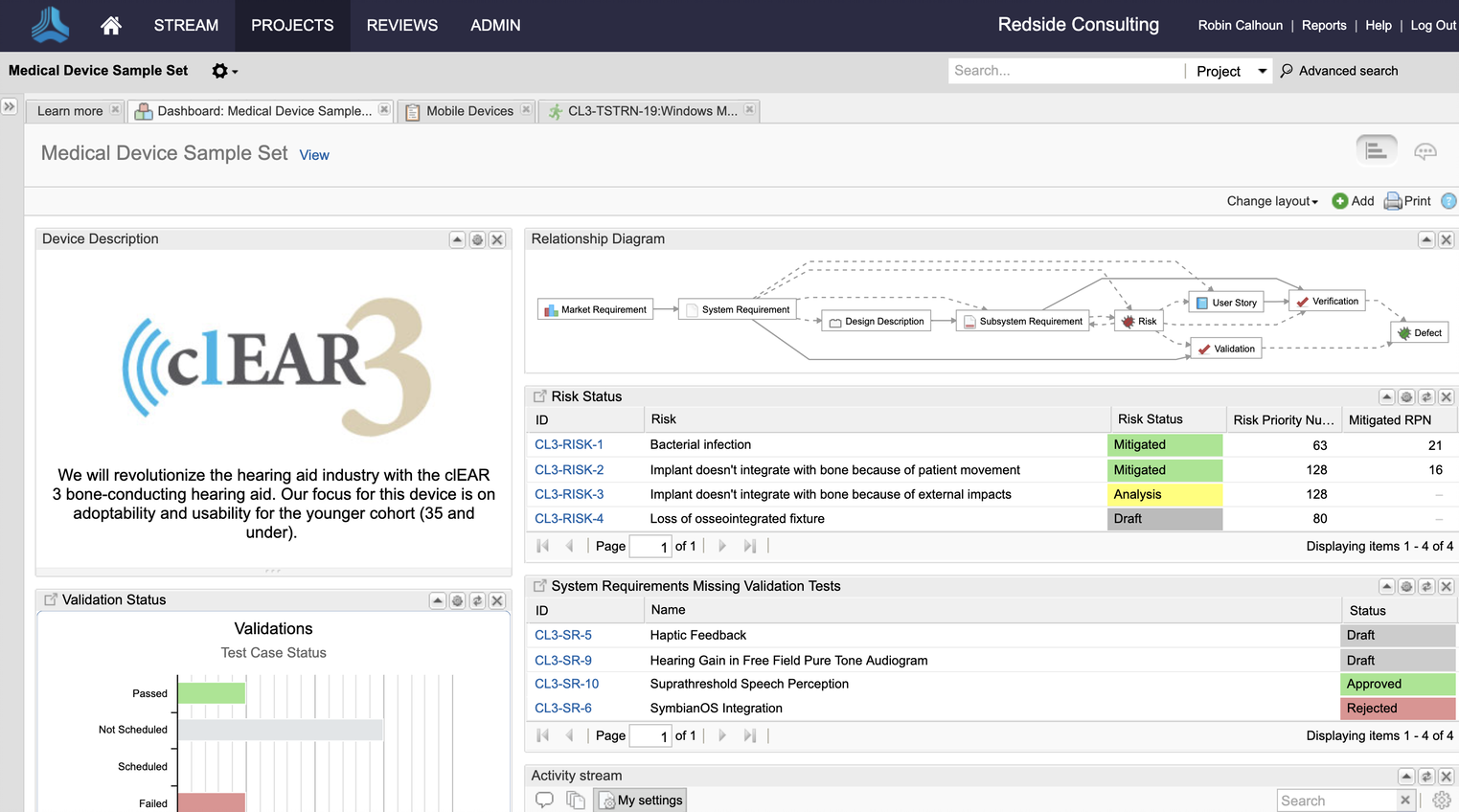
Jama Connect® is a Requirements Management software and Requirements Traceability solution. Jama Software enables teams to manage product requirements and enable Live Traceability™ across the development process, in order to reduce cycle times and improve product quality.
N/A
Arena PLM and QMS
Score 8.8 out of 10
N/A
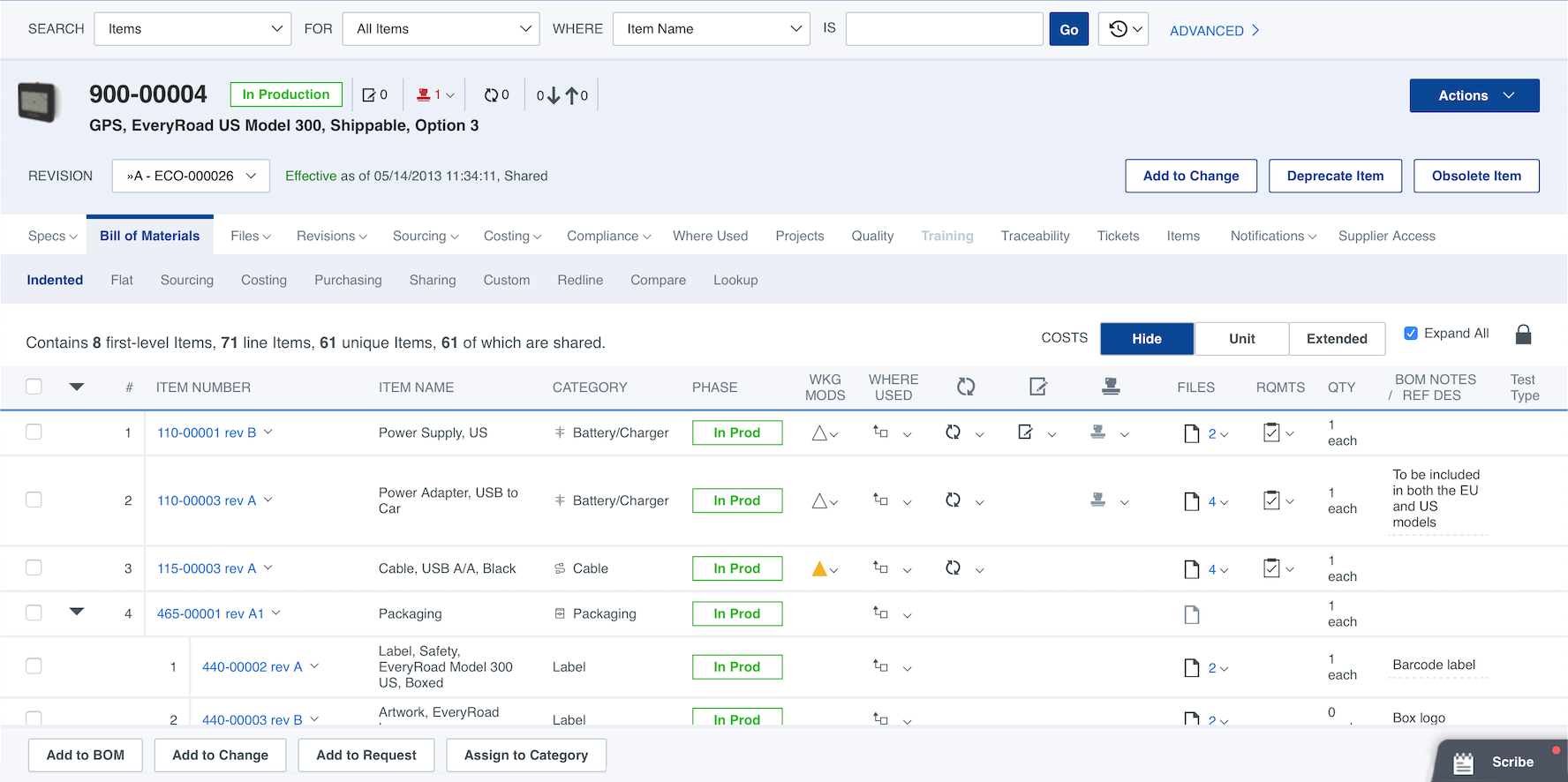
Arena by PTC is a cloud-based PLM and QMS platform. Arena helps product companies that rely on distributed teams and global supply chains to develop products, ensure regulatory compliance, and respond to customer demands.
N/A
Pricing
Jama Connect
Arena PLM and QMS
Editions & Modules
No answers on this topic
Arena PLM Launch
Contact Sales
Arena PLM Enterprise
Contact Sales
Arena QMS
Contact Sales
Arena QMS Enterprise
Contact Sales
Offerings
Pricing Offerings
Jama Connect
Arena PLM and QMS
Free Trial
Yes
Yes
Free/Freemium Version
No
No
Premium Consulting/Integration Services
No
No
Entry-level Setup Fee
No setup fee
Required
Additional Details
—
Arena's cloud-based PLM and QMS solutions include role-based subscriptions to meet diverse team needs. Their fixed-fee QuickStart™ implementations supports rapid deployment.
More Pricing Information
Community Pulse
Jama Connect
Arena PLM and QMS
Considered Both Products
Jama Connect
Verified User
Anonymous
Chose Jama Connect
Microsoft Excel provides only barebone capability when it comes to requirements development, since it is not primarily designed for that purpose. It is therefore not a serious contender to the capabilities of Jama Connect
in terms of features they were similar. The difference was due on the architecture of Jama Connect which apperas more simple and effcient. Polarion was relying to an SVN database.
Jama Connect was the perfect balance between cost, usability and scalability that our company desired. Helix was definitely cheaper but didn't offer the usability or scalability perks. Codebeamer missed the mark on cost and was designed more for a software centric requirement …
Jama Connect is more straightforward than these systems but not quite as versatile or comprehensive. I would choose those other systems if I were at a very large company working on very complex systems (which I am not).
I really liked Cradle as it seemed to be very full-featured. BUT, my liking for it was predicated on my being a daily user of the tool; it took me a while to get familiar with the tool. What was certainly true of Cradle in my experience was that it was VERY challenging to get …
Polarion did not have the outside sales support that Jama Connect has. Polarion seems better suited for an Agile development lifecycle rather than an evergreen repository of requirements, design features, and verifications.
The major sellingpoints of Jama were the review-system for internal and external reviewers and the inclusion of (Use Case) modelling tools, while keeping the core requirements-centric. Ability to synchronise with currently in use test-tooling and the low learning curve were …
JAMA can navigate between them, as far as it generates reports accessible through MS Project, Word, and Excel. Moreover, very likely it can be embedded into Confluence as well however, we have not yet implemented this feature.
From a technical point of view, DOORS is much more customizable than Jama Connect, and this is more useful when talking about SW related requirements; when talking about system related requirements, Jama Connect is well suited with respect to DOORS, in the sense that …
Jama brings requirements engineering to the 21st century and sets up the bar to measure other tools. DOORS and DNG never managed to make this jump and stayed in the past.
We originally looked at Connect (Contour) and Doors as we wanted to move away from Word documents. Contour was much easier to use and had a better collaboration environment. The was many years ago; I haven't done any comparison in the last 5+ years.
Been a long time, and it was called Agile then, and I did not use it a LOT, but my recollection was the interface was FAAARRR better than Arena PLM and QMS. Simple things like 'where uses' was a graphic with lines to all items/places where an items was used, including REF DES, …
QT9 we have used previously, and this system was much more bare bones in its offerings but was sufficient enough when we were smaller. Now, Arena PLM and QMS has far exceeded the capabilities we previously had with QT9 as it has been more seamless to integrate it with other …
Expandable is hard to use compared to Arena PLM and QMS. Arena PLM and QMS is great when it comes to following the trajectory/ life cycle of products. One thing I like about expandable is that it allows for the exportation of products and the BOM. This was a great feature that …
Arena PLM and QMS is significantly better than Mastercontrol in terms of usability. It is far more user friendly and less confusing. Arena PLM and QMS and Agile are about the same for me in terms of general user friendliness.
Duro labs did not have the best functionality or connectivity like Arena PLM and QMS does. Some syncs may be missed and not everything was update to date. Other times, some parts in BOMs would not be present and a new sync had to be performed. Any small change that Onshape …
Arena seemed the easiest to use and the one that can best be configured to our own ways of working and set up in a way that integrates well with our company
I have only used a paper system with uploads to a shared network. Paper is more time-consuming, but more in our control. It's much easier to search through Arena than a paper system, however, there is still a learning curve to Arena. Once Arena skills and company knowledge are …
Jama connect has the best UI compared to DOORS, Codebeamer, and PTC Integrity. It’s the clearest to use with the best usability. For example make traces between all requirements is as straightforward as clicking a button. The trace matrix view is highly configurable to get you to show anything you need. It has extensive filtering where every index in your requirement is indexed. Same with their export features, you can use default templates or create custom templates to export to PDF for all your regulatory needs like submitting documentation to FDA. This has helped us a ton without requiring much edits and letting us create up to date reviewed documents.
Speaking of review system, it’s well organized and you can set required approved and optional reviewers. Track your redlines in the tool and also view and resolve comments.
The one issue I’ve experienced is that with a large system the web app can take some time to load everything.
Arena PLM is well suited for part number, BOM and file management. Processing changes (ECNs, ACOs, DCO's, etc.) in Arena is very easy to do and provides great visibility on the status of submitted requests. The ability to communicate with Suppliers and grant them access to files in Arena is extremely helpful. Arena does not appear to be the best suited system for managing software
Focus in the content without loosing the track of the evolution of the items by maintaining the exchange of information between the users inside the Tool.
The possibilities to integrate this tool within our IT-landcape and with our other engineering tools is for us a leverage to success.
It provides easy, 'login-anywhere' internet cloud-based access to fundamental PLM functions.
It provides secure access control for employees & vendors (but you pay per person for access licenses).
Data is effectively 'always backed up' in the internet-cloud.
There is an option to attach thumbnail graphics representative of each item and create a Bill of Materials view that also displays the graphics to help provide item recognition for BOM readers.
The 'filtering' capabilities in Jama are not as good as they could be. In particular, the ability to "nest" filters is quite limited. I have certain seen much better capabilities in other tools. ('Cradle' is an example of a tool with excellent "nested filters" capabilities.)
From an administrative point of view, the 'License' admin view is pretty disappointing. The particular thing that I'd like to be able to find out from it is the peak number of 'Float Creator' licenses in concurrent use on each day. If there's a way to get to that information, I haven't found it yet.
Arena lacks the capability to edit documents within its interface and requires users to upload new versions of documents when changes are made. This makes it a bit more challenging to collect and implement reviewer feedback
Arena's requirement tracking world does not have the proper functionality we need and was not useful for us.
Jama is really easy to use and operate compared to other tools. This allows a process owner to get easier buy-in from the organization to see value early. My experience with this tool was very positive and we were able to see value early in its introduction
We have so much time and effort invested into Arena. The history of approvals, revisions, etc. are necessary for many of our customers. We also have entire device histories recorded. Having to re-create that on another platform would be a feat requiring years of effort. But mostly, Arena just works. It's transformed our business into a much more streamlined system, resulting in a massive cost and time savings.
The requirements and baseline parts are easy to use. The review centre is very useable and understandable, once you understand/set up the moderation. (This last part could use some refinement.) Integration/connectability (the Connect part of Jama) is quite possible, but the useability could use some love as well.
The Arena interface is fairly intuitive, and has very complete functionality. Documents are easily accessed according to prescribed user permissions, and the navigation pane is clearly positioned and sensibly structured. Notifications are sometimes a minor distraction, and document organization and hierarchy display may be difficult to follow at first. After a brief learning curve, perceived usability quickly increases for the typical user.
It has always been available, except for preventative maintenance which is announced beforehand. Nonetheless, we experienced one day shortage over a miscommunication about payment.
Seems like when I need to access our workspace for an emergency situation, this is when maintenance is scheduled, just the luck of the draw, I guess, and I just wait until the maintenance is complete, and then can proceed
With performance compared to JIRA, I do recommend Jama in this case. Jama provides very good performance, it loads immediately for any of the items and searches any item immediately. Performance is really good in all of the operations including creating stories, epics, item types or other support operations or report generation.
They typically answer within minutes of posting a ticket, and then you have a clear expectation of what the issue is, how to diagnose it, how long will it take to get resolved, and in which version a given problem is resolved, or if there is a patch for hosted services. They have a number of support people, and all of them are top-notch.
Upon initial observation, Arena Solution appears to possess a rather intricate nature, yet this complexity was effectively navigated during the initial configuration phase with the invaluable assistance of an expert well-versed in Arena, a factor that greatly contributed to our comprehensive mastery and autonomous handling of Arena Solutions thereafter.
Helpful and exhaustive and tailorable for our needs. Instructor was well versed and engaged. Material was a good reference and was up to date with tool. Overall, in person training was valuable for tool introduction. Trainer was an active user of the tool and worked closely with other clients. So, very knowledgeable.
Easy to reference and understand. Updated routinely to include new topics. Online training evolves to include more advanced topics and how to guides. Online training includes videos and reference guides that make it easy to perform more complex tasks. Online training is free and can be accessed from any computer.
The On line training was easy to understand and was very efficient for most of our users. We used the training tools to make sure we use all of the features to their fullest and correctly! After a few weeks mos of our users were very proficient with ARENA PLM and were able to work on their own and use mos of the sections and PLM capablilities.
Jama 2015.5 implementation is very smooth and no need for much manual work. Jama 8 has many challenges and we can not install it as smoothly as Jama 2015.5. Initially, Jama didn't provide the Jama 8's installer files or zip files and they were just providing docker files to everyone (which was really strange). It is the worst that they don't provide all the files at a time. Why should they tell us where we should deploy, and why only a dockerfile? I am not very satisfied with Jama implementation.
JCA is an extraordinary tool that is very simple to use and brings efficiency to the creation of requirements. It is particularly good at highlighting improvements to requirements which, when done properly and done up front in the engineering development process, will save significant time and prevent confusion downstream in the development process. It's difficult to quantify how much of a positive impact JCA would have on any individual project, but I would say it could easily save an organization more than its cost in terms of improving efficiencies and the traceability integrity throughout the entire portfolio of projects when applied correctly. This additional product from Jama is highly recommended.
I've used SAP, Agile in the past, for PLM, and unless the server is in your office, you cannot configure anything, and should it crash, you as the client are stuck until the issues are resolved. In my 15 plus years using Arena, there has only been one instance where the server was down, and the support team quickly resolved the issue with no loss or data or breach of any kind. Both PLMs are very light on what you can configure for your own company, most of it is out of the box, and you are stuck with it, whereas Arena Solutions gives you much more freedom to really tailor it to your company's specifics and what works for you.
There is no horizontal scalability available in Jama, we have only one choice to scale it vertically. But vertical scalable applications always have limitations to grow. In this case, Jama doesn't support horizontal scalability functions like multi-node architectures with a shared drive for the home directory.
Arena is easy to customize and therefore easy to scale. Different user groups with access restrictions can be easily created and new training plans can be created to support different user bases. Suppliers can also easily be added or items can be shared with them
One experience that converted an engineer to using Jama Connect was an electronics engineer that was writing test plans. I showed them about how to write "unit" or very discrete tests and then showed them an automatic export to get the document. Thus the authoring of the document effort was taken away, they could focus on defining the test
Unfortunately I have very much struggled to embed systems engineering, requirements management and Jama Connect as part of the 'ways of working' outside the systems and electronics teams.
Arena PLM and QMS has allowed [...] to efficiently respond to Design Changes and process them effectively.
Arena PLM and QMS has completely automated our CAPA process, removing all paperwork and 99% of other electronic files.
Arena PLM and QMS has allowed our Contract Manufacturing Organizations (CMO) to upload current manufacturing data; this puts [...]'s finger on the pulse of a CMO thousands of miles away. No more surprises.