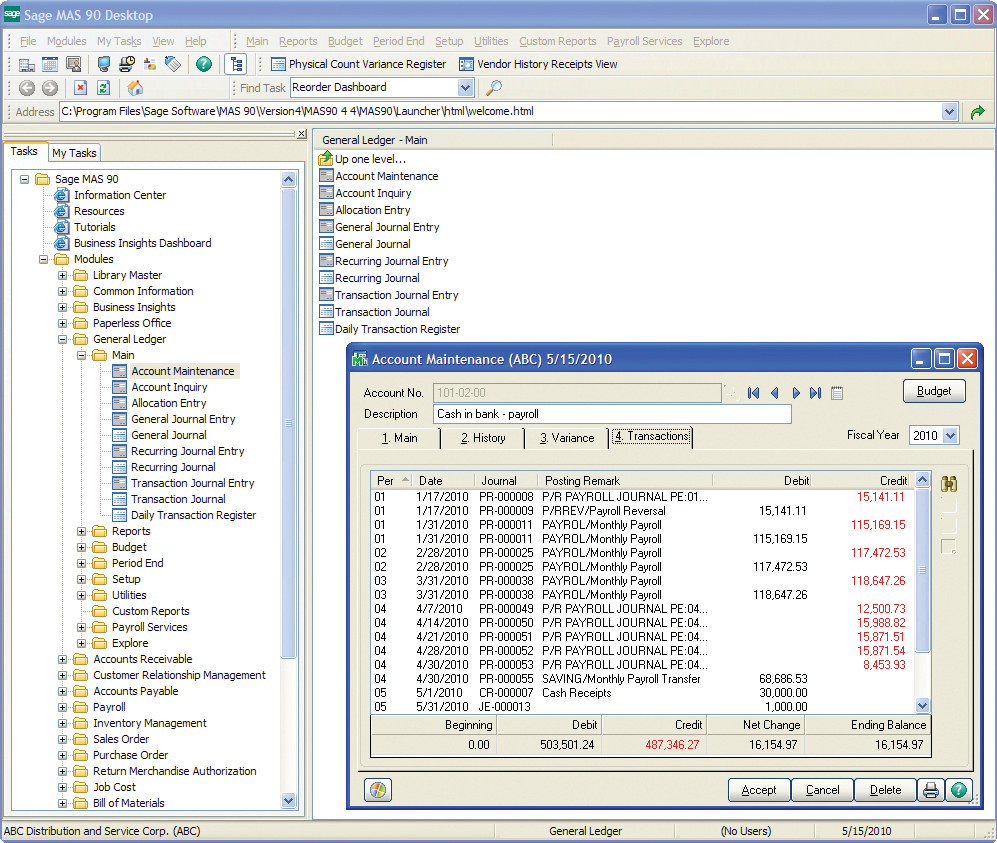
Sage 100 (or Sage 100cloud is a business management software offering a broad range of modules designed to meet the many needs of virtually any business. It encompasses financial operations and accounting, payroll, business intelligence, CRM, eBusiness, manufacturing and distribution.
N/A
Sage 50
Score 8.3 out of 10
Small Businesses (1-50 employees)
Sage 50cloud Accounting (formerly Sage 50 Accounting) is accounting software designed for small businesses. Sage 50cloud Accounting (formerly Sage 50, and formerly Peachtree) lets businesses invoice customers, pay bills, manage inventory, control costs, and pay employees. The solution includes high-level dashboards and in-depth reports.
$61.92
per month
Pricing
Sage 100
Sage 50
Editions & Modules
Sage 100 ERP Standard
Custom Pricing
Per Seat per Month
Sage 100 ERP Advanced
Custom Pricing
Per Seat per Month
Sage 100 ERP Premium
Custom Pricing
Per Seat per Month
Sage 100 ERP Online
$0
Per User per Month
Sage 50 Pro Accounting
$61.92
per month
Sage 50 Premium Accounting
$103.92
per month per user
Sage 50 Quantum Accounting 3 User
$177.17
per month per user
Offerings
Pricing Offerings
Sage 100cloud
Sage 50
Free Trial
No
Yes
Free/Freemium Version
No
No
Premium Consulting/Integration Services
No
No
Entry-level Setup Fee
No setup fee
No setup fee
Additional Details
—
Annual billing plans also available for all products.
More Pricing Information
Community Pulse
Sage 100
Sage 50
Considered Both Products
Sage 100cloud
Verified User
Anonymous
Chose Sage 100cloud
I didn't choose Sage 100 ERP -- it was already in use when I started at the organization over five years ago. It has the same types of pros and cons as other big hulking software suites meant to power the infrastructure of corporations. It's slow, tough to customize, and …
All three products are very good, but at some point reach their limits and Sage 100 ERP becomes a very good, easy to use, cost effective solutions. It is also more secure than QuickBooks or Sage 50.
I have used mainframe type programs with more bells and whistles than Sage 50. For what we do, that expensive software is a waste of money. Sage 50 is a solid program. I have used QuickBooks and they have online software that is an advantage. But it's not as good in ways an …
Sage One and QuickBooks Online can only support a micro-business. Microsoft Dynamics is too hard to use. Sage 50 is just right. Sage 100 is the big brother for the larger business needing more depth in the modules.
Features
Sage 100
Sage 50
Payroll Management
Comparison of Payroll Management features of Product A and Product B
Sage 100
8.5
Ratings
17% above category average
Sage 50
8.9
Ratings
14% above category average
Pay calculation
8.00 Ratings
10.00 Ratings
Benefit plan administration
8.00 Ratings
8.60 Ratings
Direct deposit files
10.00 Ratings
8.00 Ratings
Salary revision and increment management
00 Ratings
8.90 Ratings
Reimbursement management
00 Ratings
8.90 Ratings
Customization
Comparison of Customization features of Product A and Product B
Sage 100
6.5
Ratings
16% below category average
Sage 50
10.0
Ratings
27% above category average
API for custom integration
3.00 Ratings
10.00 Ratings
Plug-ins
10.00 Ratings
10.00 Ratings
Security
Comparison of Security features of Product A and Product B
Sage 100
5.0
Ratings
48% below category average
Sage 50
8.9
Ratings
7% above category average
Single sign-on capability
4.00 Ratings
9.00 Ratings
Role-based user permissions
6.00 Ratings
8.70 Ratings
Reporting & Analytics
Comparison of Reporting & Analytics features of Product A and Product B
Sage 100
7.0
Ratings
3% below category average
Sage 50
9.8
Ratings
22% above category average
Dashboards
2.00 Ratings
9.30 Ratings
Standard reports
9.00 Ratings
10.00 Ratings
Custom reports
10.00 Ratings
10.00 Ratings
General Ledger and Configurable Accounting
Comparison of General Ledger and Configurable Accounting features of Product A and Product B
Sage 100
7.6
Ratings
2% below category average
Sage 50
9.2
Ratings
17% above category average
Accounts payable
9.00 Ratings
10.00 Ratings
Accounts receivable
9.00 Ratings
10.00 Ratings
Global Financial Support
5.00 Ratings
9.00 Ratings
Primary and Secondary Ledgers
9.00 Ratings
10.00 Ratings
Journals and Reconciliations
9.00 Ratings
9.20 Ratings
Configurable Accounting
9.00 Ratings
9.90 Ratings
Standardized Processes
9.00 Ratings
9.90 Ratings
Cash management
00 Ratings
8.90 Ratings
Bank reconciliation
00 Ratings
10.00 Ratings
Expense management
00 Ratings
8.50 Ratings
Time tracking
00 Ratings
8.30 Ratings
Fixed asset management
00 Ratings
6.80 Ratings
Multi-currency support
00 Ratings
6.90 Ratings
Multi-division support
00 Ratings
9.00 Ratings
Regulations compliance
00 Ratings
9.00 Ratings
Electronic tax filing
00 Ratings
9.80 Ratings
Self-service portal
00 Ratings
9.00 Ratings
Intercompany Accounting
00 Ratings
8.60 Ratings
Localizations
00 Ratings
10.00 Ratings
Enterprise Accounting
00 Ratings
10.00 Ratings
Centralized Rules Framework
00 Ratings
9.80 Ratings
Inventory Management
Comparison of Inventory Management features of Product A and Product B
Sage 100
6.8
Ratings
15% below category average
Sage 50
9.4
Ratings
24% above category average
Inventory tracking
6.00 Ratings
10.00 Ratings
Automatic reordering
6.70 Ratings
8.90 Ratings
Location management
6.00 Ratings
10.00 Ratings
Manufacturing module
00 Ratings
8.90 Ratings
Order Management
Comparison of Order Management features of Product A and Product B
Sage 100
7.8
Ratings
1% below category average
Sage 50
9.2
Ratings
17% above category average
Pricing
9.00 Ratings
9.90 Ratings
Order entry
9.00 Ratings
9.90 Ratings
Credit card processing
4.00 Ratings
7.90 Ratings
Cost of goods sold
9.00 Ratings
6.80 Ratings
Order Orchestration
8.60 Ratings
10.00 Ratings
End-to-end order visibility
00 Ratings
9.90 Ratings
Order exception Resolution
00 Ratings
10.00 Ratings
Subledger and Financial Process
Comparison of Subledger and Financial Process features of Product A and Product B
Sage 100
7.7
Ratings
3% above category average
Sage 50
-
Ratings
Billing Management
7.00 Ratings
00 Ratings
Cash and Asset Management
7.00 Ratings
00 Ratings
Travel & Expense Management
6.00 Ratings
00 Ratings
Budgetary Control & Encumbrance Accounting
8.20 Ratings
00 Ratings
Period Close
7.00 Ratings
00 Ratings
Project Financial Management
Comparison of Project Financial Management features of Product A and Product B
Sage 100
8.0
Ratings
5% above category average
Sage 50
-
Ratings
Budgeting and Forecasting
9.00 Ratings
00 Ratings
Project Costing
9.00 Ratings
00 Ratings
Cost Capture
8.00 Ratings
00 Ratings
Capital Project Management
8.60 Ratings
00 Ratings
Customer Contract Compliance
7.80 Ratings
00 Ratings
Project Revenue Recognition
7.80 Ratings
00 Ratings
Project Execution Management
Comparison of Project Execution Management features of Product A and Product B
Sage 100
5.0
Ratings
32% below category average
Sage 50
-
Ratings
Project Planning and Scheduling
5.00 Ratings
00 Ratings
Task Insight for Project Managers
5.00 Ratings
00 Ratings
Project Mobile Functionality
5.00 Ratings
00 Ratings
Definable Resource Pools
5.00 Ratings
00 Ratings
Grants Management
Comparison of Grants Management features of Product A and Product B
Sage 100
7.0
Ratings
7% below category average
Sage 50
-
Ratings
Award Lifecycle Management
7.00 Ratings
00 Ratings
Procurement
Comparison of Procurement features of Product A and Product B
Sage 100
5.0
Ratings
33% below category average
Sage 50
-
Ratings
Bids Analyzed and Compared
5.00 Ratings
00 Ratings
Contract Authoring
5.00 Ratings
00 Ratings
Contract Repository
5.00 Ratings
00 Ratings
Requisitions-to-Purchase Orders Integrated
5.00 Ratings
00 Ratings
Supplier Management
5.00 Ratings
00 Ratings
Risk Management
Comparison of Risk Management features of Product A and Product B
Sage 100
4.4
Ratings
39% below category average
Sage 50
-
Ratings
Risk Repository
5.00 Ratings
00 Ratings
Control Management
5.00 Ratings
00 Ratings
Control Efficiency Assessments
5.00 Ratings
00 Ratings
Issue Detection
3.00 Ratings
00 Ratings
Remediation and Certification
4.00 Ratings
00 Ratings
Logistics
Comparison of Logistics features of Product A and Product B
Sage 100
7.1
Ratings
6% above category average
Sage 50
-
Ratings
Transportation Planning and Optimization
7.00 Ratings
00 Ratings
Transportation Execution Management
7.00 Ratings
00 Ratings
Trade and Customs Management
7.00 Ratings
00 Ratings
Fulfillment Management
7.00 Ratings
00 Ratings
Warehouse Workforce Management
7.60 Ratings
00 Ratings
Manufacturing
Comparison of Manufacturing features of Product A and Product B
Sage 100
8.2
Ratings
10% above category average
Sage 50
-
Ratings
Production Process Design
8.40 Ratings
00 Ratings
Production Management
8.40 Ratings
00 Ratings
Configuration Management
8.40 Ratings
00 Ratings
Work Execution
8.00 Ratings
00 Ratings
Manufacturing Costs
8.00 Ratings
00 Ratings
Supply Chain
Comparison of Supply Chain features of Product A and Product B
Sage 100
7.8
Ratings
9% above category average
Sage 50
-
Ratings
Forecasting
8.00 Ratings
00 Ratings
Inventory Planning
8.00 Ratings
00 Ratings
Performance Monitoring
7.60 Ratings
00 Ratings
Product Lifecycle Management
Comparison of Product Lifecycle Management features of Product A and Product B
For small and medium business in the distribution and light manufacturing space, Sage 100 is probably the best bang for your buck. As a very scaleable system, you can modify the system to meet the needs of a growing business without making gross changes to the core of the system
Sage is great for portability and exchange with external accountants as it is widely used and people will be able to read your data in. It's a very good and complete solution for a little business where one person can handle all of the accounting. I doubt that it scales well to large companies with several in-house accountants working at the same time.
I like the automated guides to set up complex features of payroll formulas.
The business intelligence reporting seems very comprehensive, so that one could really "crunch the data" and analyze different aspects of their business.
Sage annually improves the performance and features of their program.
The out of the box reports are not appealing and take a bit to clean up during the end of the month. The set up of the reports can be quite tedious and not very intuitive. They need to do a better job of adding the drop and drag tool in a more visible way so that it is easy for the end user.
Sage needs to add the ability for the users (in a controlled environment) to manipulate the look and feel of the input screens. It gives you minimal options to add fields to certain areas.
The help feature does not have the "google" type of intelligence that allows you to search on phrases. If it is not exact, it does not do a very good job of filtering through items that you really don not need. I have used more of the internet searches to figure out my problem because it wasn't easy to pull up the help option in Sage.
I would put this out to bid, if I were at the same organization. There have been a lot of improvements and changes in enterprise software and my preference would be to find a good web-based or cloud-based tool. Lower overall cost of ownership and improved efficiency would be my target criteria for a rebid of this.
I use this rating simply because I have a thriving Sage 50 consulting practice and will continue to keep my expertise in the product. I have consulted on both Sage 50 and QuickBooks for over 25 years so I have to maintain expertise in the solution as well as accounting and verticals.
Overall Sage 100 has been pretty user friendly. If we have a question on anything, we are able to contact our implementation rep who helps us right away. Some of the Sage Field Operations may not be as intuitive for our field personnel to use. I wish the reports ran faster so that we could run and put together many reports quickly at once.
I think Sage 50 is a trusted product and is reliable from a product delivery and support perspective. They have deep domain expertise in the non-profit space and should be a consideration for new non-profit startups or existing non-profits looking to migrate from other platforms. Overall, I believe that Sage 50 does many things well with few limitations.
We use a local software technology partner to help support our Sage100 needs. We do not need much assistance with Sage100. There are very few issues or questions.
The support from Sage is quick, easy to understand and always relevant. They are very responsive to queries and this enables us to have very little down time if the product does fail for whatever reason. Having someone on the end of the phone who can solve your issues is invaluable.
We had an advantage in implementing the tool in that our director of Ops had been part of the team implementing the ERP for other users so we knew what to expect and were able to avoid a lot of the challenges people sometimes face with implementations. However, the process still took far longer than desired.
Sage 50 is a strong accounting software package. It will work efficiently if it is installed correctly. If one puts garbage in, one will get garbage out. Also it is important to train the staff to use Sage 50 properly. It is also important to set up security for each user.
We have used Foundation and it did not work out well, so we selected Sage 100 because the implementation and functionality was much better. We didn't have to keep coming up with workarounds or complications on Sage 100. Also the data security is better.
Sage Accounting is better suited for smaller organisations with fewer transactions. The invoicing system of this piece of software is a superior tool, however. Sage HR is more commonly used for employees to access payslips and record things such as annual leave or overtime. Sage Intacct is likely a more practical solution for a larger organisation with a higher volume of transactions.
I define scalable from two perspectives; 1) the scalability to handle more bookkeepers/accountants using the product, and 2) the scalability to handle increasing customer/vendor/employee and transactional data. Sage 50 does a good job on both fronts. From the single users operating a micro-business accounting for customer invoices and bill payments only, to the multi-staff, multi-location, multi-departmental complex transactional operation. Although Sage 50 is quite expensive for that smallest user, it is quite inexpensive for the larger business entity. So, for the new enterprise expecting rapid growth, Sage 50 is the application of choice.
Sage 100 has allowed us to better serve & manage our customers since we integrated it into our system in 1996. Since then, we have seen a lot of changes but, the consistent, simple layout has kept us re-newing our contract year after year.
Ordering inventory has been easier than ever since we integrated inventory tracking. No more ordering too much or too little.
It has allowed for more emphasis on sales than data entry which has allowed the Wholesale division to grow
The "On Screen" credit status on the Sales Order feature has given the capability to free up inventory for paying Customers which increased Turnover, while keeping Past Due to a minimum
The Reporting has allowed for yearly, prior year and Budget Variance Reporting for the Sales Reps so they can stay or target
The Inventory Reporting and Receiving keeps a grasp on damaged based on Lots received which helps to notify the Parent company of production issues and monitor shrinkage
The Credit with Job and RGA capability give a clear view of which Customer are having warehouse issues or if we are having Freight Carrier issues