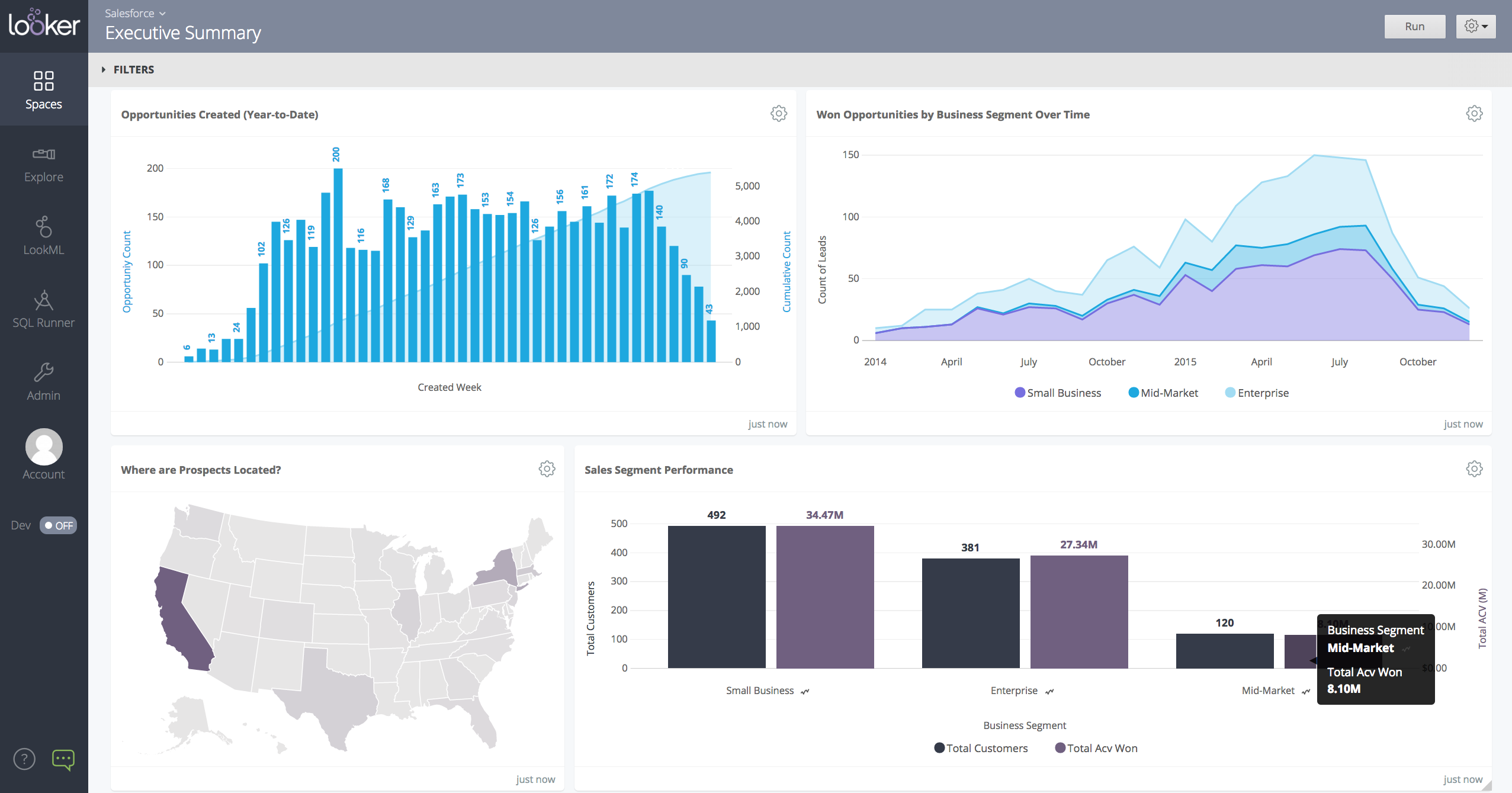
Looker is a BI application with an analytics-oriented application server that sits on top of relational data stores. It includes an end-user interface for exploring data, a reusable development paradigm for data discovery, and an API for supporting data in other systems.
N/A
Sigma
Score 9.1 out of 10
N/A
Sigma Computing headquartered in San Francisco provides a suite of data services such as code free data modeling, data search and explorating, and related BI and data visualization services.
I am not an expert in any of these, though from my brief exposure to Looker it felt like a steeper learning curve, more appropriate to companies with dedicated and skilled BI engineers, whereas Sigma (and Tableau, and Looker Studio) offer a quicker and more intuitive interface …
I'd rate Sigma to be extremely similar to Sisense except it looks not as nice. I would say that as a tool, Sigma is more user-friendly than Tableau, Power BI, Trevor, and Metabase.
I do feel that Looker is far more powerful and looks great, but I also recognize that Looker does …
With Looker, to be effective, a substantial amount of coding & modeling needs to happen in LookML. Being another language to learn, users have to context switch again from at a minimum either SQL or Python into LookML. The concept of being able to source control, code review, …
I was not involved in the decision-making process, and we stopped using chartio because it was discontinued. Chartio was great for looking under the hood at individual queries. Sigma is superior in the visualization aspects - it looks more professional and clean-cut. I've …
I prefer Google Sheets, Looker, and Tableau over Sigma Computing. I was not involved in the purchasing decision but if it were up to me, we would use a different tool.
Sigma has the capabilities of the other BI tools. I think it's pretty user friendly and easy to learn. Many of our stakeholders are used to using Excel so it's nice that it is a smooth onboarding process for them. We haven't looked into much of the visualization capabilities so …
flexibility, works really well with Snowflake, export capability, level of support, the fact that Sigma Computing is a start up and improving so quickly. Web based software
Easy entry tool that can grow with you as the data expertise and literacy grows within the org. Start up effort and cost is too high in the tools that are built for large corporate solutions.
Google Data Studio is free, intuitive and easy to use but the analytics are limited. In-table calculations can't be done easily and it lacks a native connector for Snowflake. Moreover, table columns cannot be arranged in any order--they must be dimension first, and metrics …
Sigma was chosen for three reasons. 1. Excel-like workflow. Many of our researchers have a background in excel, and the excel-like workflow Sigma offers enabled them to get up and running quickly. 2. Embeds. We can easily embed dashboards into our SAS platform 3. Price. Sigma …
Sigma has a good balance of affordability, self-service ability for technical teams, and ease of use. We chose it over the others basically based on ROI.
Sigma Computing was our top choice due to the ease of use of the platform for end users doing self-exploration of data. The structure of the platform for how datasets are created and access provisioned was much better than other products we considered. Sigma Computing may not …
Sigma is my least favorite BI tool I have used. Its unintuitive, takes longer to develop on, and has very limited functionality to re-use work (ie scripting, copying to a new project).
Sigma's combination of key features from each of these with native dB access under a UI that makes collaboration easy has made it an easy choice for us.
When you need to create a centralised dashboard for multiple stakeholders that blends cross-channel reporting. As an SEO agency reporting for clients - Looker is a great solution. It's less appropriate depending on the intended users. For instance, in my experience Looker reports have been under-utilised because they're not accessed regularly, provide too much noise or often simple PDF reports are preferred
Scenarios where Sigma Computing is well suited: - Data Reporting and Visualisation : It is suitable for dashboards that integrate data from multiple back-office systems - Search and Filtering Capabilities: It provides a robust platform for searching through datasets and visualisations. Scenarios where Sigma Computing is less appropriate: Handling of null values and dynamic table adjustments
Viewer level license is quite limited. These users can't download data or even add filters on datasets. Something to keep in mind.
Directly querying the underlying data warehouse will lead to increased usage. Not a big deal on something like Redshift, but your Snowflake consumption will increase, potentially by a lot.
We are very haooy with Looker, it provides us with all the funciomalities we need for both the day to day oerformance tracking and longer periods reporting. It is easy to use for account managers, configurable and customizable for soecialists and what is most imoortant, our clinets generally really love it
Because we are very satisfied with the product and would most likely renew because of the services it provides. It is a tool that you bring into your organization and let it change the way you analyze your data, present your data and share you date within the Respective teams
Looker is relatively easy to use, even as it is set up. The customers for the front-end only have issues with the initial setup for looker ml creations. Other "looks" are relatively easy to set up, depending on the ETL and the data which is coming into Looker on a regular basis.
It has a clean and modern interface. However, it is not completely intuitive. I think it would be better and easier to navigate with more Windows style drop down menus and/or tabls. There is a significant learning curve, but that may be due in part to the technical nature of this type of software tool.
Somehow resources heavy, both on server and client. I recommned at least 50Mbs data rate and high performance desktop comouter to be abke to run comolex tasks and configure larger amount of data. On the other hand, the client does not need to worry when viewing, the performance is usually ok
Never had to work with support for issues. Any questions we had, they would respond promptly and clearly. The one-time setup was easy, by reading documentation. If the feature is not supported, they will add a feature request. In this case, LDAP support was requested over OKTA. They are looking into it.
They are very friendly and informative. They are quick in resolving our queries and help us understand very minute things as well. They are quick in creating feature tickets based on our custom requirements, and they would also create a bug ticket if there is any discrepancy and get that checked on time.
In my opinion, Looker is no Power BI. It is good, but I think Power BI is amazing. That said, in my experience, Power BI is nowhere near as easy to setup and report on Google services as Looker is. We plan to continue using Power BI for c-suite and corporate reporting, especially for internal databases, but will gladly use Looker for our marketing information for AdWords, Analytics, Search Console, and YouTube.
I am not an expert in any of these, though from my brief exposure to Looker it felt like a steeper learning curve, more appropriate to companies with dedicated and skilled BI engineers, whereas Sigma (and Tableau, and Looker Studio) offer a quicker and more intuitive interface for smaller companies like ours without dedicated BI resources on staff.
Other than some people not liking the numbers, I don't see any negative impacts; we haven't experienced that.
The reports help us unravel the story of our users and how they are sifting through our pages.
Our clients enjoy seeing the numbers to understand better what stands out on their sites.
The reports have helped us see what campaigns are working and where we need to tweak things.
The reports have enabled us to have better conversations with stakeholders about how their web pages should be modified, edited, etc., to reflect the data.
Monitoring health of cloud platform has allowed the company to anticipate issues before they affect customers – Sigma prompted us building a canary monitoring process that provides customer container health.
Customer success has used an activity report to discover customers running runaway processes that they were unaware of, creating an alert to contact the customer and prevent an embarrassing situation.
Customer success uses the activity report to prompt conversations regarding increases or declines in behavior that led to increasing contract limits or addressing churn concerns.