Slack is a group messaging or team collaboration app that aims to simplify communication for businesses. Features include open discussions, private groups, and direct messaging, as well as deep contextual search and message archiving, and file sharing. Slack integrates with a number of other tools, such as MailChimp, Dropbox, and Google Drive. Slack was acquired by Salesforce in December 2020.
The product is free to use, and also has paid plans with more features and greater controls.
The…
$0
Zimbra
Score 6.8 out of 10
N/A
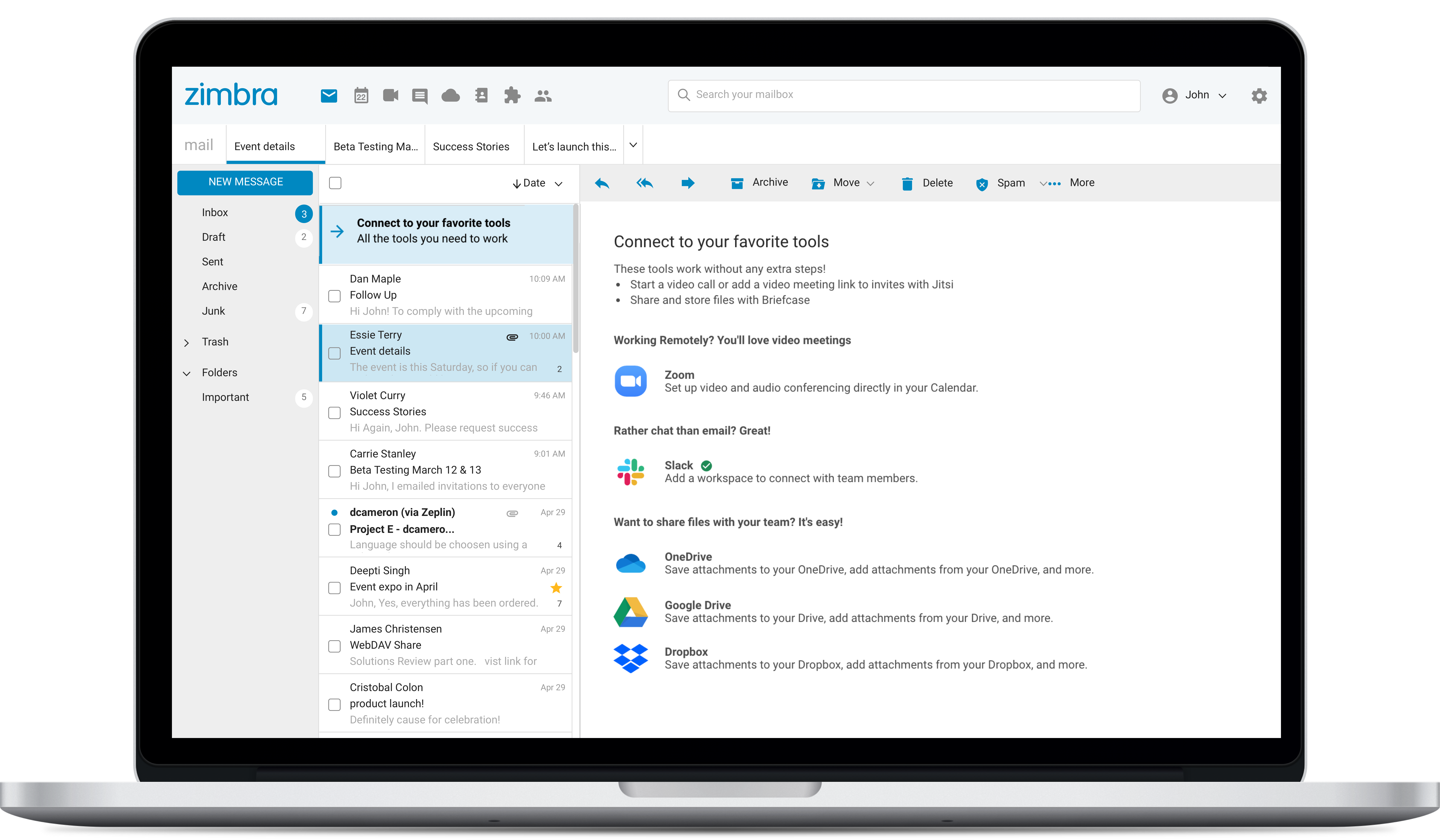
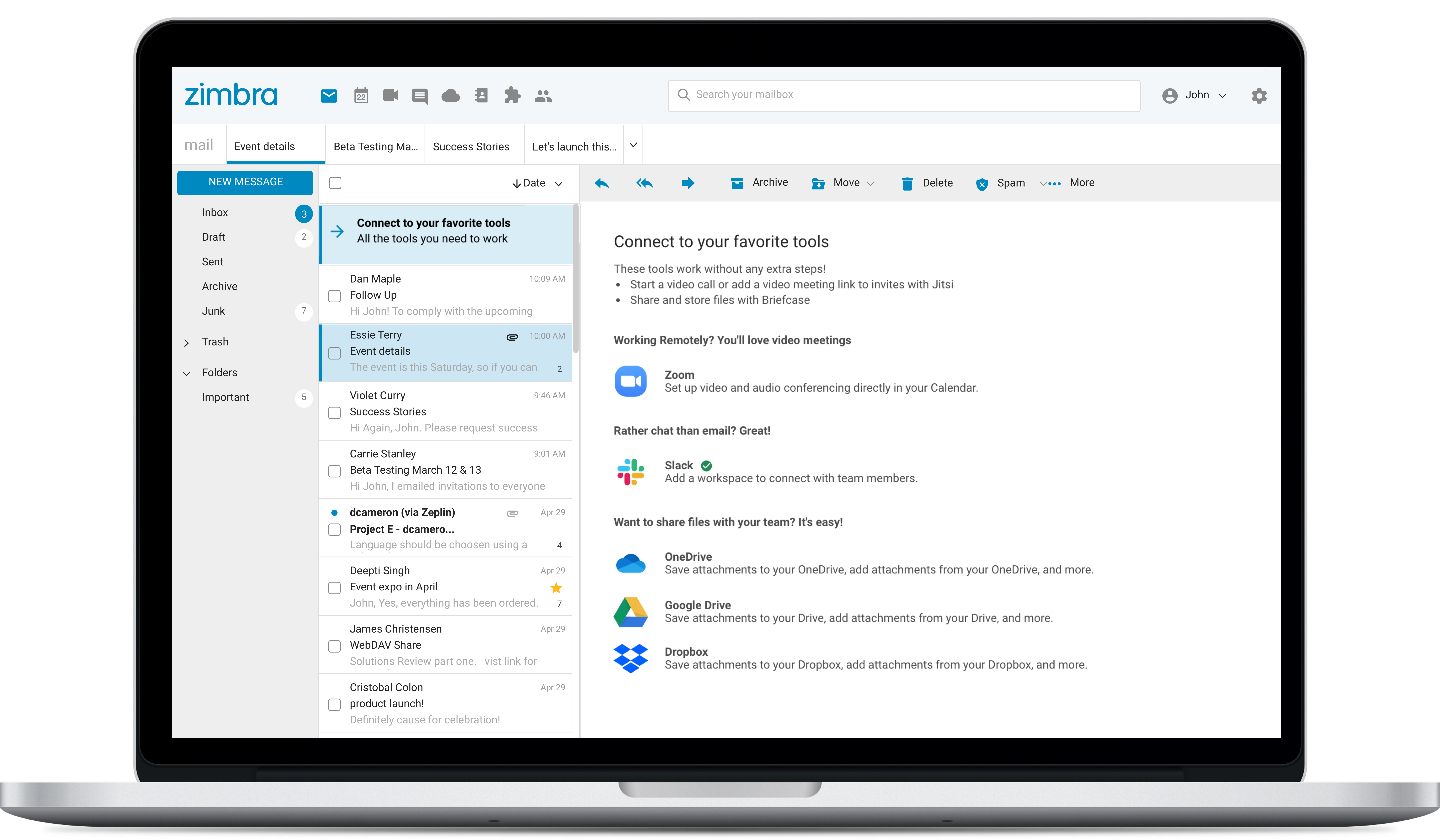
Zimbra is an email and collaboration platform and productivity suite that includes contacts, calendar, tasks, chat and file sharing, plus videoconferencing, document editing, and file storage.
N/A
Pricing
Slack
Zimbra by Synacor
Editions & Modules
Free
$0
Pro
$7.25*
per month per user
Business+
$12.50*
per month per user
Enterprise
Contact Sales
No answers on this topic
Offerings
Pricing Offerings
Slack
Zimbra
Free Trial
Yes
Yes
Free/Freemium Version
Yes
No
Premium Consulting/Integration Services
No
No
Entry-level Setup Fee
No setup fee
No setup fee
Additional Details
*Per active user, per month, when paying once a year.
Pro is $8.75 USD per active user when paying month to month. Business+ is $15.00 USD per active user when paying month to month.
Slack is far superior to Google Chat. There is much better organization and separation of groups/topics using channels and folders. I also believe that Slack is better than Teams. It has many integrations and functionality that make it similar, while also being more of a modern …
Microsoft Teams is slightly more user friendly, due to it being connected to email. It connects to your calendar and is helpful to keep everything together. The notifications are a bit more helpful on Miro because it is live. I enjoy the ease of communication on Teams. It's …
Slack is far superior to other interoffice communications I have used. It has more features for messaging like the ability to include emojis or react to messages. You can also edit and share messages between conversations. I'm not sure how other platforms have evolved but I …
I evaluated Skype for Business, Microsoft Teams and Google Chat. Slack stood out for its user friendly interface, powerful integrations and fast flexible communication. Microsoft teams felt more formal and complex, while Google chat lacked features. Slack best matched our …
our team's current non-Microsoft(Google) tech stack, hard-coded into our workflow. It's infinitely more customizable than Teams, easily meeting our requirements. Additionally, Slack has unlimited external users, whereas Teams has limitation, so Slack is the obvious choice for …
Slack works great with Salesforce and seems the most trendy. MS Teams has some more connectivity with the MS suite which is nice though and a bit more robust as a communication platform when using it for both chat and video. We use a combo of Zoom and Slack for internal …
I have used Teams, Instagram, and WhatsApp for business, but Slack stands out for how organized and work focused it is. Unlike WhatsApp, which is more casual, or Instagram, which is not built for very professional and secure work chats, Slack keeps everything structured with …
Trello is a task management tool platform that best complements Slack. Even though you can tag different team members to boards or specific tasks, Slack provides a more robust platform to communicate and share files, ideas, or issues about a task. And can be used as a general …
I think obviously Slack is much much better than Google chat, in my previous organisation, we used to communicate everything via Google chat or email or Google meet, it was difficult to manage because those application combined had less options and features than Slack.
Slack has just been the best communications tool for our team. Slack integrations are the best, the fact that its multi-device functional and has great features like file sharing at a fast speed, screen sharing, quick and easy to use. I do not think we would ever consider and …
Slack: It's easy to strike up a chat right away with one-click calls or huddles. By simply pressing the call button, both users are involved without the need to arrange a meeting. Microsoft Teams: With calendar invites, time slot choices, and numerous confirmation processes, …
The UI is difficult to understand and also to find a particular chat it is difficult to search in Teams. Also Slack has cool features like Slack Workflows and To do lists and Slack Canvas which makes life more easier. Slack apps to integrate existing app and also I use Slack to …
It is superior to other products in its ability to communicate quickly with other colleagues. I can collaborate and work on multiple projects with colleagues. It is just an amazing product to use at work. I like the ease of using the tool. It’s a much better product than teams …
I absolutely hate Microsoft teams, I dislike Google chat, I really like Slack. The main reason for that rating boils down to UI and usability. At my company, we have to use teams and chat still when we are interacting with customers or certain other departments within the …
Slack offers better chat then google chat for mobile devices AWS the Slack chat bot is more informative and efficient to use Azure dev ops and Slack are great to have side by side
We did not found the same level of features on all these products. Where Slack is better than other ones, is that you are interacting with other really fast, you can jump in open channels, private channels, be updated about topics and also manage different workspaces. The …
Slack is still one of the best Chat tools on the market, but Zoom Team Chat (Zoom Workplace) is coming up quickly and overall, provides a great tool that is included at no cost. I believe that Slack still has some development advantages over the competitors at this point still, …
We used Zimbra Email & Collaboration in two scenarios: first, on-premise with the open-source version to save costs, especially since solutions like Office 365 or Google Workspace were not as mature or widespread at the time. Later, we benefited from cost advantages with Zimbra …
There are a lot of features that Zimbra Email & Collaboration has that gmail and m365 have. You can chat within your team members with Zimbra Email & Collaboration. The issue that we have not been able to figure out though is mobility of Zimbra Email & Collaboration. You can …
We chose Zimbra because Zoho Mail is too pricey with less-functionality than Zimbra. Zoho's UI is better, but we need more than just UI, we need many features that Zimbra has. G Suite is the best for team collaboration of course, but because of the price and our needs we …
Zimbra is undeniably a complete package and offers many practical tools, in addition to the knowledge that the company has. It is a great acquisition for a company that will soon see a significant change in terms of organization, deadlines, efficiency, and more. It has an …
Zimbra is a more specialized software designed for our company and its needs. The software was customized to represent our colors and project our brand, what other companies do not have. With Zimbra, we have a private network of only employees which allows us to confidentiality …
Zimbra is a significantly cheaper option than one of the Microsoft solutions, such as Exchange. It is able to run in a free environment, as it is in the case of Linux. It offers the advantages of a powerful mail manager, such as indexed searches and the integration of contacts …
We selected Zimbra because it has a lower cost in the market, offers more development features for its open source, has a very easy to use interface and adjusts to the needs of the company.
Zimbra provides a robust and reliable software that delivers what is promised. We have tested Zimbra in a pilot project before deploying it in production. Incidents and crashes are rare and you have tools to recover it if necessary. Initially we had a contract with support to …
We were originally a Groupwise shop before changing to Zimbra in 2008. Zimbra, from an end-user standpoint, pricing, system administration, and management is a far better system.
We use Google Apps for our students. We did not find it to be suitable for faculty and staff due to …
Slack is really effective for smaller teams to use as an internal communication platform. I think that it's still suitable even for companies of up to 500-1000 employees, but for larger teams it's less appropriate (or would require more aggressive organization, e.g. keeping channels protected and on an invite-only basis). It's really helpful for small team-to-small team communication too (like in our case where we create external channels to support POCs/business partnerships). It's not great for direct collaboration (e.g. it's hard to iterate on a project spec or a document together, directly in Slack) but it's well suited for conversational coordination, like planning meetings or asking informational questions.
I consider Zimbra Email & Collaboration a viable alternative to the major American cloud email platforms. In a scenario where data protection and privacy are critical, especially in an on-premise environment, Zimbra is a very suitable solution. It is also capable of offering a comprehensive set of tools and additional features (tasks, calendars, contacts, briefcase) in an integrated manner.
Undoubtedly Slack’s search function is powerful but sometimes it is difficult to find specific messages or files in very active channels with high message volumes. This needs an improvement.
I have experienced notification issues on my phone. I am not receiving notifications and have missed important updates as a result. I tried uninstalling and reinstalling the app, but the problem still persists.
The Business Plus plan does not include support for data loss prevention or offline backup providers.
User web interface could be more friendly, but it is enough for daily use. It could be renewed and has to consider some usability concerns. Improving usability would significantly improve users' satisfaction.
Message backup recovery is not a simple activity.
As an administrator, some of the features work better using the command-line interface.
The webclient uses ajax requests in almost every event. Because of that you may need a fast internet connection to have a good experience. You can switch to HTML version but it will limit what you can do.
Slack sitll lacks in functionality. It's better than Skype for Business in many ways, but it is still another chat/message board app. It has limits in free version and paid versions. Also Windows app has errors that bother me, for example, I see number on one of my team's icons. It suggests that one of channels has unread messages; I check all channels - no unread messages, but that "1" still appears
The web usability of the solution is adequate, with all functions integrated into a single interface. However, it is important to note that in the desktop environment, it lacks its own application and relies on ActiveSync synchronization with reference solutions like Outlook or Thunderbird. Some features, such as the briefcase, will be excluded. The same happens on smartphones.It is also common for competing solutions to include integrated chat or video call tools, which Zimbra lacks. These shortcomings are among the most frequently requested by users.
Yes, the app works 24/7. I don't even recall having any period that we could not use since the implementation. Even the maintenance periods are barely noticeable and our work is not impacted by it when it happens.
Slack is a soft app, we don't have many issues with it. I recall one or two people complaining about something during our usage period, but I didn't have a bad experience. When the app is slow, usually the problem is with my computer or my internet. The app works just fine.
Whenever I've had to troubleshoot an issue with Slack (which, to be honest, has not happened very often), their online documentation has been easy to locate, easy to understand, and effective in resolving my issue. Slack's ever-growing popularity also means that there's a large community of practice out there that can be depended upon.
Overall, we were satisfied with the implementation. We perhaps should have spent more time consulting with Zimbra or others regarding best practices but as we got to know the system better we were able to make changes relatively easily after the fact.
I like Slack better than ClickUp, because I would spend 30-60 minutes a day updating my ClickUp tasks. The way ClickUp was used was very micromanaging. I billed by the hour, so I was willing to put in the time to alert the boss what tasks I was working on.
One of my jobs used Hive - I mostly just ran it in the background in case anyone messaged me. I did not use it often.
We were originally a Groupwise shop before changing to Zimbra in 2008. Zimbra, from an end-user standpoint, pricing, system administration, and management is a far better system.
We use Google Apps for our students. We did not find it to be suitable for faculty and staff due to its lack of shared accounts.
We are moving from Zimbra to Office 365. Office 365 offers just about all that Zimbra had, though its web interface is inferior to that of Zimbra. It does offer us greatly reduced costs though, and high availability. If Zimbra were to have a fully HA environment, we may have stayed with them.
Slack has been incredibly helpful in connecting various tech apps and ecosystems, creating a more streamlined and responsive process.
Slack has made it significantly easier to communicate with our team members across multiple time zones, creating a more engaging environment for our all-remote team.