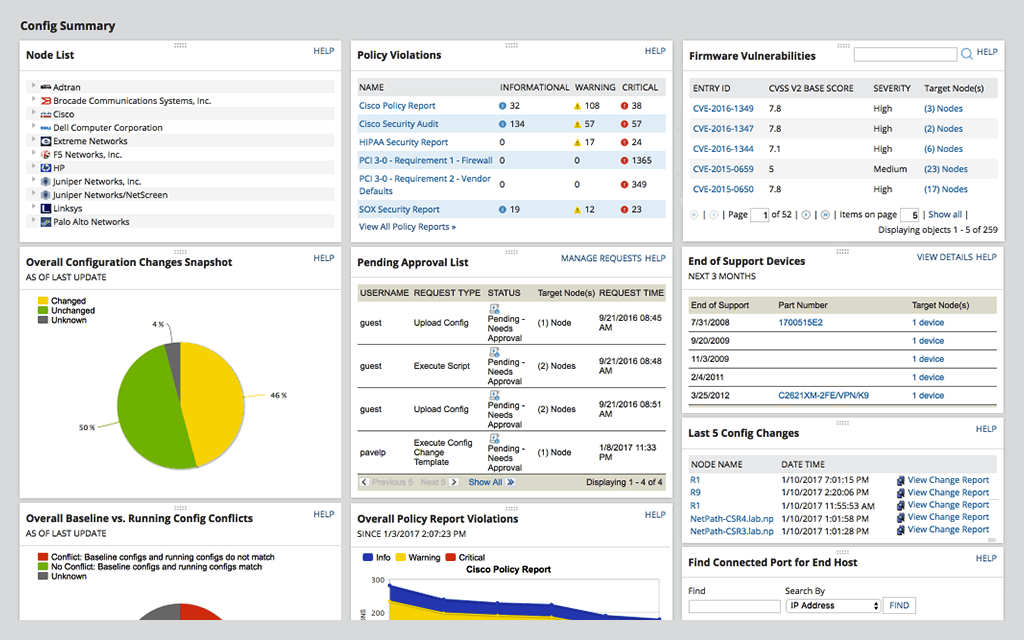
SolarWinds Network Configuration Manager is network diagnostics and troubleshooting technology, from Austin-based SolarWinds.
N/A
Zabbix
Score 8.7 out of 10
N/A
Zabbix is an open-source network performance monitoring software. It includes prebuilt official and community-developed templates for integrating with networks, applications, and endpoints, and can automate some monitoring processes.
We evaluated PRTG Network Monitor which was similar to SolarWinds but was very resource-intensive and the server kept crashing when we got close to 100 devices
whereas on SolarWinds we were able to add several thousand devices. We
also evaluated Nagios Core as a free …
Solarwinds Network Configuration Manager is extremely powerful in allowing our organization to automate specific tasks. It is extremely simple to use and offers a Graphical User Interface for performing tasks. I am a very curious person, which has led me to use Ansible simply …
All of the SolarWinds solutions stack up against their competition. The customer support is excellent, KB articles are details, and the community (Thwack) is the best when it comes to working through complex configurations/monitors. These are the things that make them the right …
At the time SolarWinds was the biggest player in the space and their whole portfolio was very comprehensive. As time progressed and newer technologies came about (i.e. SDWAN) their products couldn't keep up with the consumer demands and changing market. Security became such a …
The product is easy to use, has great support, and is more cost-effective than the other products on the market. I would recommend this to anyone who asked for my opinion.
Red Hat Ansible Automation Platform is a great tool and matches much of the functionality of SolarWinds Network Configuration Manager. Nothing about Ansible will likely be overwhelming to an engineer with a little time to spare, but that spare time combined with SolarWinds …
I actually prefer the ManageEngine Network Configuration Management engine product but switched to SolarWinds Network Configuration Manager to standardize to our Orion deployment.
We had previously used cattools and rancid for configuration management. Cattools is another Solarwinds product but one that we outgrew and doesn't integrate with the Orion platform like SolarWinds Network Configuration Manager (NCM) does. Rancid it seems a lot of engineers are …
The SolarWinds NCM product stacks up well compared to just about any other product on the market. The NCM tool is super easy to use and will complement every Cisco or Aruba product that you may have.
If it has been used and it has been functional since it reduces the work time by more than half, making the process faster, safer, and more precise, carrying out not so complex and functional processes referring to configurations of multiple devices at the same time in an agile …
SolarWinds NCM solution is more flexible and GUI is from my point of view more intuitive, from the other hand Manage Engine solution is [a] cheaper solution which has almost [the] same functionality but suffers of luck of deeper integration with other Manage Engine modules.
LogicMonitor is very basic when it comes to config management, with support for a limited number of devices (though sufficient for us) and minimal frills/features. While we could have used it for the BC/DR portion of our solution, we wanted the better config diffs, compliance …
I have not had the opportunity to evaluate any of them, NCM has been the only software that has been used in recent years, and due to its good design, I have not had the need to look for additional software it meets my expectations and those of the manager.
SolarWinds Network Configuration Manager (NCM) was by far the easiest to implement and it just started working right out of the box. Within a few hours were we populating our config backup repository and soon after that, we were writing scripts to audit our configurations. …
We are looking at puppet just to keep our options open. This is more my area because I don't have to rely on windows. Sure there's some learning you need to do, but it runs on a solid system. Not much else we are looking at for comparison. Now if NCM moves to another OS, well …
We did not evaluate any other similar products. When the need for a config manager arose, we already had a heavy investment in SolarWinds, so using another SolarWinds module made the most sense for us.
We have a very diverse IT environment (Cisco/Palo Alto, VMWare, Cisco UC, SD-WAN, Windows Servers) and we wanted to have one suite of software that we could manage as many of our different areas in one single pane of glass. SolarWinds allows the network team, VOIP team, Storage …
The software's I mentioned are great, but they are overpriced comparing to Zabbix while it's a free open-source application. The value its adding has high price than any other free open-source apps. the monitoring and alerts details and the friendly user interface is stacking …
As I have mentioned before, its free, open source, very customizable and easy to use. I think anybody with minimum networking or computer knowledge can watch tutorials and implement this solution easily. Also it has great community support and forums
Zabbix is very easy to configure and this tool provides a more active alert system. We have evaluated ipMonitor and CloudWatch but the scope for sending alerts is very limited and this tool is very efficient in sending alerts through emails, MS Teams, and even on SMS. We are …
We're using the Solarwinds suite as our global monitoring standard, but it is very complex and its licensing model makes it difficult to monitor a wide range of technologies. So, we're using Zabbix as a complement on our monitoring process. Zabbix is a way more flexible and has …
We're using Munin in parallel to Zabbix, mostly out of legacy reasons. While Munin in the version used here only allows static graphs through image-files, Zabbix clearly wins here with the option to zoom in and out.
I used Nagios many years ago and it was quite similar to …
Although we still use Cisco Prime for network devices, when comparing Zabbix with Nagios, for example, you see that Zabbix is more robust, stable, easy to deploy and has an enterprise focus that other tools don't have. Also, the fact that the Zabbix community is very active is …
Most of the SolarWinds are separated out, whereas Zabbix includes templates and capabilities for all of them out of the box. Other solutions listed include most or all of them to varying degrees as well.
New Relic is more for Application Monitoring, but the New Relic …
Zabbix was adopted in our framework due to the value, the hardware requirements, the knowledge we had available and the vast documentation on the internet.
Zabbix is a great, free solution. While not everything is discovered and configured out of the box, it is a powerful tool that allows for complete customization to what your organization needs as far as a monitoring solution. We've invested the time to make Zabbix powerful, …
Zabbix was much better at handling traditional systems, and in ease of customization, both in the system itself, and customizing data sources, such as adding deep MySQL or JMX integrations. It's very good for organizing large-scale (hundreds or thousands of servers) systems; …
I personally prefer Zabbix over any other monitoring software that I have ever tried. Zabbix is so customizable that if there is a feature I need, I can easily implement it. I can then add that feature to a template in no time and have it applied to hundreds, or even thousands, …
More extensive and customizable than SaaS solutions. Much less learning curve than Nagios. Cost is very much lower than SaaS monitoring especially at scales over 1000 hosts ($15,000/month for SaaS!!) Templating systems allows for easy management and monitoring of groups of …
Zabbix is cost effective maybe and certainly a good tool but not the best. The other ones have features that Zabbix is missing and we use couple of them.
Zabbix had the best support for the devices I initially had in my network, its ability to adapt and change has made it my Swiss Army knife of monitoring tools. While it could benefit greatly from a moderated zabbix community, its support from the open source community has …
Nagios has some advantages over Zabbix like "flapping" detection and multiple alert levels - Error, Warning and OK. However, the disadvantages of Nagios like needing an addon (NRPE) to monitor remote system internals (open files, running processes, memory, etc), no charting of …
Nagios will always be at or near the top, but I really like how sleek Zabbix is. Also, once it's up and running its really helps keep things in order for you and your customers. As for PandoraFMS, it would have beat out Zabbix, but the documentation on PandoraFMS is really …
I have had feedback that Splunk is a more out-of-the-box solution. With some fine tuning, it is possible to get the same robust functionality from a Logstash and Zabbix integration. The setup is more taxing, but you avoid paying the costly Splunk fees. So it all really depends …
I'm mostly familiar with Zabbix, but I've also started working with OpenNMS more recently. It appears that they're very comparable, the major difference being that OpenNMS supports SNMP Traps natively and can import MIBs which I was never able to figure out with Zabbix. Like …
Well, I am not a decision-maker here, but I believe Zabbix has been adopted as a default choice to be integrated with Nokia OpenStack because of its simplicity of usage & other products were not matured at that time. Single GUI can be used for infrastructure as well as workload …
There was a need to find an old configuration of a network switch that was accidentally wiped clean. Fortunately, SolarWinds Network Configuration Manager (NCM) kept and archived a backup copy of the switch device in question! We were easily able to upload the configuration file to the switch and restore the device back on the network in a matter of minutes!
Because we spread out in different locations, we can't always know the status of our devices. Zabbix solves this issue for us. As soon as we see an alert that the remote site is down, we can solve it right away. I can't think of a scenario where it was less appropriate for us.
Alerts; Zabbix allows deep customization of conditions and alerts giving you the ability to perform nearly any scripted action in a variety of scenarios
Inventory; having one place to see a list of all on-going problems and list of servers within your organization is critical
Graphs; screens or graphs showing customizable and color-coded historical usage is a necessity in any monitoring software
For our use case, it does everything great and some of the features we underutilize but I would like to be able to set a configuration baseline when initially adding a node instead of after the configuration is pulled but it's not a particularly big deal to let it pull the configuration then set it as the baseline.
Medium complexity to set up in the beginning if using any non-standard devices or configurations, else fairly easy (e.g. Cisco Nexus or IOS-based devices). Reports are fairly straightforward to set up. Updates to the platform are fairly straightforward and don't take a major effort. Easy to add or remove devices.
It is free. It didn't cost anything to implement (other than my time and the cost incurred for it) and it is filling a badly needed gap in our IT infrastructure. Support is available if we have issues and can be done annually or paid for on a per incident basis as needed. Expansion, updates, and all other future lifecycle activities are likewise free of cost, so as long as someone is able to implement/maintain the software (and the OSS project is maintained) then I imagine the company will never leave it.
The user interface is lacking. It is difficult to navigate at times and things can be done multiple ways. Quite often I am confused by how their notification structure works. It is not very intuitive. They do offer a free Academy. They also offer a community of other technical folks. I have enjoyed both.
Well i find the tool quite useful for my daily network monitoring purpose. We get the alerts easily through SMS which saves us lot of our times and effort. The tool is highly customizable which i mentioned earlier which helps to create different alert criteria for different device or system.
To be fair, I have not had to involve Support in a number of years, but when I did, I was greeted with enthusiastic engineers who wanted to understand and solve the issue. It was a fairly complex scenario and I have discovered in my most recent implementation that engineering included that option as a standard now.
The setup is the most time-consuming portion of using zabbix. It takes a lot of effort to shape it into a usable format and even then it can get very messy. It's not exactly intuitive and as mentioned the UI seems a bit antiquated. If I was to roll out a monitoring solution from scratch, I'd probably look for alternatives which are easier to use and maintain.
Solarwinds has actually produced new training since I last used it that is available on their site at any time. Their previous training was more than enough to get us started but now there is significantly more content. Since I'm comfortable with the Orion platform and the products we use I haven't checked the new training out yet but we have new staff go through portions of that training and they always come away with an understanding of the platform and ready to use it
We are a mainly Windows environment, so it would be useful if we could have used Active Directory to deploy agents. As of version 4.2, Zabbix has announced a new agent MSI file to allow exactly that. Unfortunately, we didn't have that option. Also, for Linux and MAC deployments, there is no simple way to deploy that. Using remote scripts you may be able to create something, but most places will opt for either SNMP (agentless) or manual installation of agents to add to Zabbix. A way of deploying agents via discovery would go a long way to helping in the adoption of the tool.
At the time SolarWinds was the biggest player in the space and their whole portfolio was very comprehensive. As time progressed and newer technologies came about (i.e. SDWAN) their products couldn't keep up with the consumer demands and changing market. Security became such a big focus that once Solarwinds got hacked we had to remove all their products from our environment
The software's I mentioned are great, but they are overpriced comparing to Zabbix while it's a free open-source application. The value its adding has high price than any other free open-source apps. the monitoring and alerts details and the friendly user interface is stacking up against any other apps in the web.
Saves 100s of hours a year in man hours over manual configuration.
Saved easily 50k in lost revenue when a switch rebooted with months old unsaved configuration. NCM let us quickly restore a snapshot of the running config from the previous day.
Saves us several man hours per week of config auditing by reducing all changes to a summary email.
Zabbix has had a positive impact on uptime of our external facing website. Users don't always call up our Customer Service team to report that something is down - sometimes they just abandon the website all together. By having a monitoring solution that tells us when things are down before customers do, we are able to respond quickly and avoid losing visitors and ultimately sales.