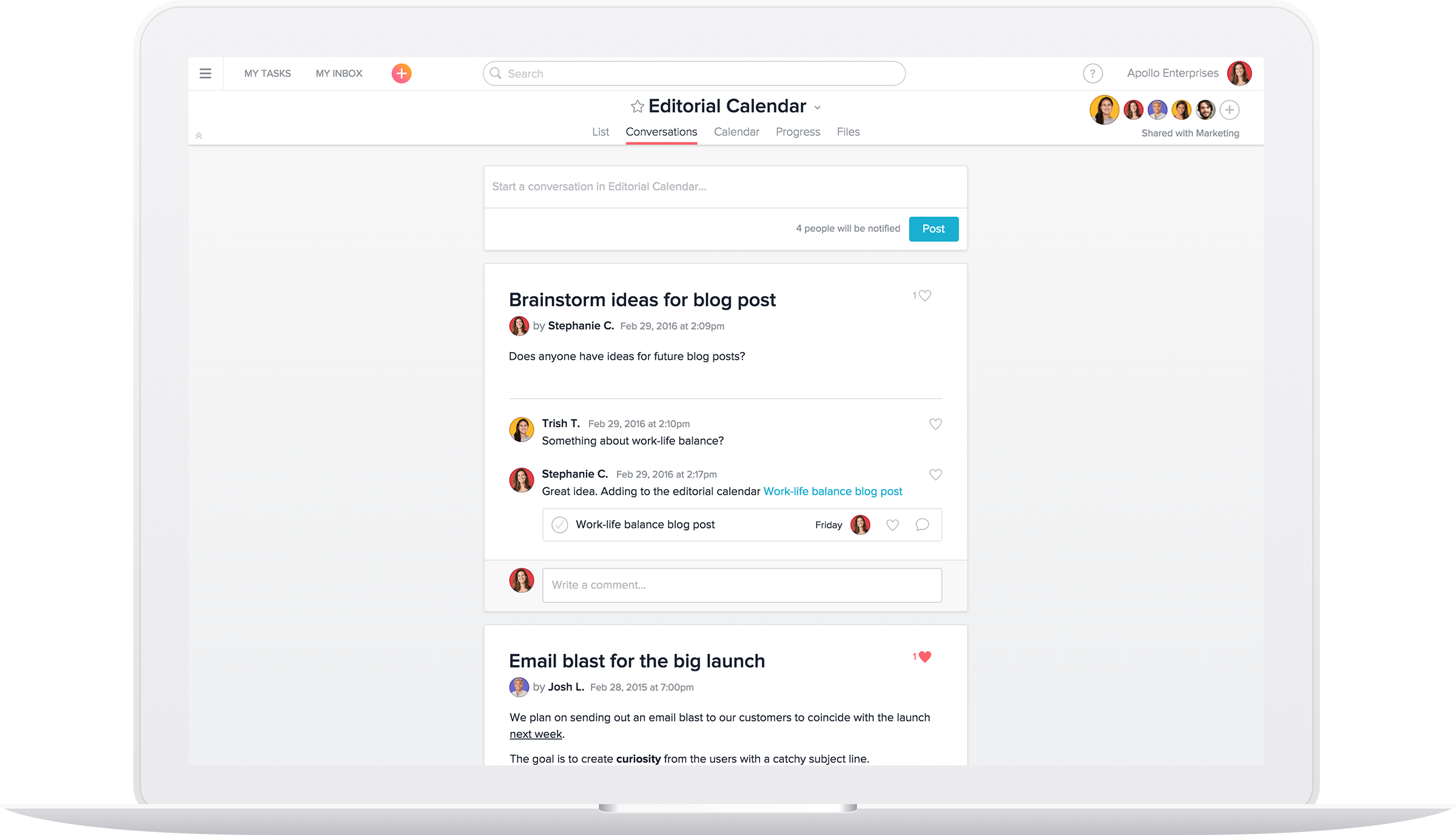
Asana is a web and mobile project management app. With tasks, projects, conversations, and dashboards, Asana lets an entire team know who's doing what by when, enabling workload balancing. Users can also add integrations for GANTT charts, time tracking and more.
$13.49
per month per user
Microsoft Teams
Score 7.9 out of 10
N/A
Microsoft Teams combines video conferencing software with team collaboration tools. The communications platform allows MS Office users to conduct conference calls and share files via SharePoint, and join or initiate a group chat.
$4.80
per month per user
Pricing
Asana
Microsoft Teams
Editions & Modules
Starter
$13.49
per month per user
Advanced
$30.49
per month per user
Enterprise
Contact Sales
Personal
Free
Microsoft Teams Essentials
$4.80
per month per user
Microsoft Teams Enterprise
$5.25
per month (paid yearly) per user
Microsoft Teams Enterprise
$5.25
per month per user
Microsoft 365 Business Basic
$7.20
per month per user
Microsoft 365 Business Standard
$15
per month per user
Offerings
Pricing Offerings
Asana
Microsoft Teams
Free Trial
Yes
Yes
Free/Freemium Version
Yes
Yes
Premium Consulting/Integration Services
No
No
Entry-level Setup Fee
Optional
No setup fee
Additional Details
A discount is offered for annual billing.
Discounts are available for non profit organizations.
More Pricing Information
Community Pulse
Asana
Microsoft Teams
Considered Both Products
Asana
Verified User
Anonymous
Chose Asana
Asana is the best for task management, it’s easy to use and streamlined for team members to use with minimal intervention. It’s a lot nicer to use compared to similar products like Projectplace although there is some difference in features. It has much better features in terms …
Microsoft Teams is great for collaboration, communication, and chatting, but does not have near the amount of features Asana does for task management. We use teams to communicate and Asana to track tasks and projects.
Asana provides a mix of features between notion and Jira. Unlike Notion, it helps ease up the collaboration on vast projects and between multiple teams. Jira proved to be a little expensive with similar set of features if not more and which is why we thought of going with Asana.
Asana is amazing for a remote team, that we are currently as its accessible seamlessly to all our team member no matter where they are in the world. Its very easy to onboard new members to this platform as its very intuitive and easy for new people to get a hang of it. It has …
Asana does well at the assignment of tasks and task management, but it is not a resource planning tool. Other tools do better at resource planning and some principles of agile/scrum. It is simple and easy to use within the mobile application and on desktop, but it doesn't have …
We have a lot of different software available and different teams are using different products. I think Asana is comparable to many of the other software that we use. It was slightly less intuitive than I would have expected, but it did help keep everyone updated on the project …
I have been using Smartsheet for a similar project management usage with a customer of ours. Asana is way better than Smartsheet with a much better user interface and experience.
I liked Slack just as much as Microsoft Teams. We opted to stay with Teams because we were already using Microsoft Office and I think this integrates better with Office.
Microsoft Teams is a clear winner for robustness and for integration. It has the entire Office 365 toolkit in its corner and for an enterprise level solution, it doesn't have many peers, at least at that level of comprehensiveness. There are some peers that might compete well …
Microsoft Teams is definitely a strong contender to Slack. For small organizations with small teams, Slack has a clear advantage in term of setup and ease of use. However, for large organizations with dedicated and specialized IT Administrators the task of setting up Microsoft …
Teams really lacks a lot of basic integrations, bots, the ability to close out/archive unused channels/groups, etc., in comparison to Slack, but it's a pretty good solution for a more established organization. While I personally still prefer Slack over Teams, I've also grown to …
The usability of Asana is broad since it's available in a variety of platforms that are widely used nowadays. I think that it would be great for people who are constantly on the move and switching devices, since it has allowed me to work from my phone, too. I also think that Asana has proven itself to handle a large quantity of work
Microsoft Teams is ideal for organizations where employees regularly collaborate by sharing files, working on the same documents, updating the progress, etc. This is because different file formats are supported for online editing and collaboration with the help of Microsoft Teams. Additionally, for every file which is shared among the team members, emails are not sent again and again which helps in easily managing and organizing files. It is less appropriate where the team members have to instantly reply to an urgent task as sometimes the notifications are not sent properly which may lead to a delay in the work.
Video calls are great with Microsoft Teams. They've made big improvements over the last year and I rarely have issue with getting on. It's nice when things just work.
The most used functionality is, of course, the chat feature. It does what it's supposed to do and you can create chat groups from whoever you'd like. We use it a lot when there is a special project and a team from various groups get together for a short period of time to get things done.
An overlooked function is the ability to search anything within Microsoft Teams. Any photo, document, or chat can be searched and found pretty easily. I can't tell you how many times this has saved me from having to rewrite something or start over.
I just can't see us getting it off of Asana any time soon, despite the many headaches it has caused us. We have too much data in there, too much time & training invested into it, too much at stake to move. If we were just starting out today, fresh, I don't know for certain that I would absolutely go the same direction, but I *think* I still would. I just haven't seen anything better yet. Maybe if Podio's support staff hadn't treated me like a worthless nuisance to them, I might feel differently, but the fact is that their task management is simply inferior to Asana's. That can't be denied, and in fact Podio said it themselves: "Tasks are a simple function. They cannot be customized. Tasks in Podio can be used for quick to-do's for you and your team members." In our operation, however, prompt task completion is a big deal; one task can't be completed until another one is done first, and closing the gaps between those tasks is critical in meeting deadlines and servicing our customers. Asana gets us there, the others don't.
Microsoft Teams is included with our Office 365 subscription and we have no intention of migrating off of Office 365 and Microsoft products. Since Microsoft Teams is included for free with our Office 365 subscription, and since we enjoy all the features, benefits, and functionality, there is no question that our team will continue to use the product
It is very user-friendly. Takes a new employee an hour to start figuring out how the system works. That's an important factor. You don't want to encounter the issue where employees need a week to understand how the system works. For example, JIRA, I tried using it for a week and I still don't understand the complicated layout. Asana has a simple interface. Once you see it, you get it type of program.
The overall functionality of the product is incredible in that it provides a one-stop solution for organization and communication. The product is also very well integrated into Microsoft Outlook and other Office apps. Visually pleasing and very easy to use interface. New features are constantly being added to enhance the user experience.
I haven't had to use their support so I can't rate it. The fact that I haven't needed them reflects the ease of use of the product. I would recommend that any new users schedule a complete demo of the product to ensure that they are using it to it's fullest (there's a lot of useful features).
I think Microsoft Team is overall good application for communication, track Project work inter the teams and also intra teams. I have 7 out of 10 because it needs improvements in certain features like video sharing call, call drop, audio quality and connecting problems even after having good internet connection.
Asana is a top-tier project management software that helps us organize and track projects from start to finish. It allows us to apply tasks/to-dos to multiple projects without duplication, divide complex projects into smaller tasks, and track project progress. It also helps us organize work on Kanban boards or linear lists. It stands out from the crowd in a big way compared to the competition.
We chose primarily because of the promised integration with the Microsoft Business Suite - which it mostly delivers on. That does give Teams an obvious advantage over competitors. IMHO Teams has a richer, more mature feature set, and the experience is more reliable and stable. Although like any of there there is room for imporvement.
User experience has been much better than the previous Skype for Business app. It has an easy-to-use interface with persistent chats. The search feature is very fast and useful.
MS Teams has mostly focused on Collaboration and team building features which are very useful for organisational communications. This in turn has a positive impact on the overall business outcome.
Scheduling meetings have never been so easy in the past. We can schedule meetings on the go without any hassles
Since Teams is accessible from multiple platforms like Laptop, Desktop, Mobile phones, etc it has been very convenient from a Mobility perspective.