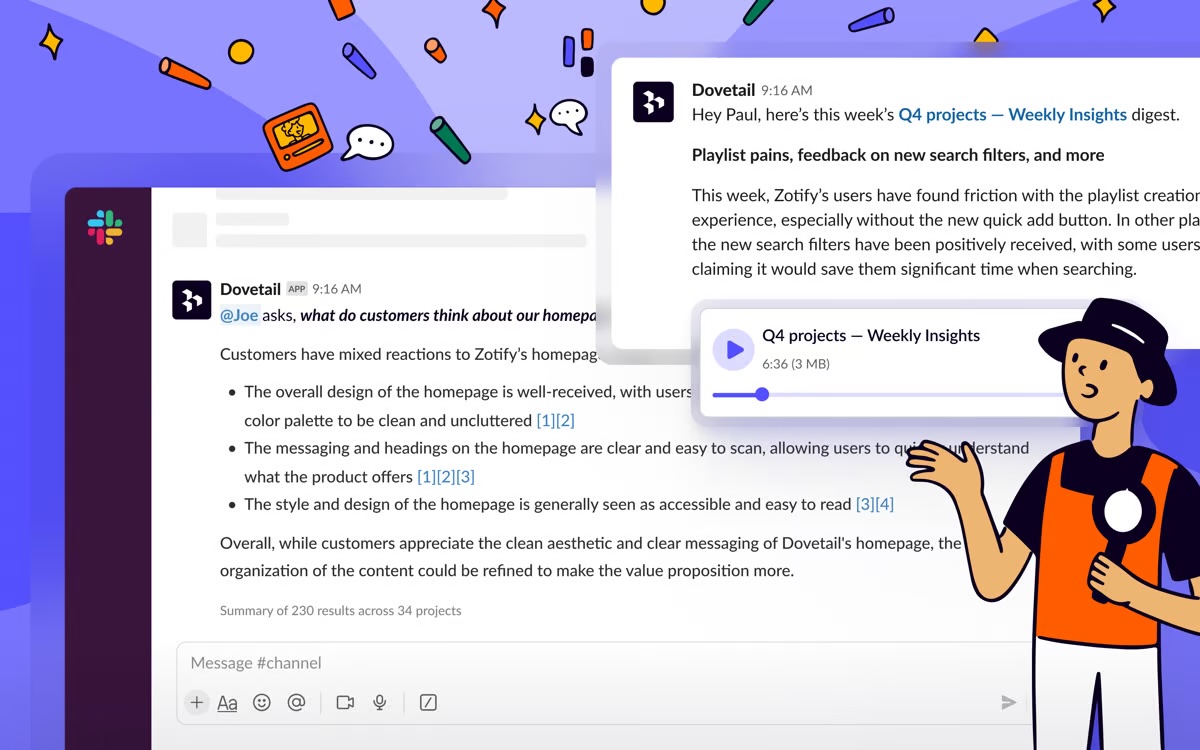
Dovetail, headquartered in Sydney, aims to enable the world to create better products and services through deep customer understanding. Dovetail states they empower 45,000+ people, from agencies to universities to Fortune 100 companies, to make sense of their customer research in one collaborative research platform.
$0
Pricing
Crazy Egg
Dovetail
Editions & Modules
Crazy Egg
$24.00
per month
Free
$0
Professional
$15
per month
Enterprise
Contact Sales
per year
Offerings
Pricing Offerings
Crazy Egg
Dovetail
Free Trial
No
Yes
Free/Freemium Version
No
Yes
Premium Consulting/Integration Services
No
No
Entry-level Setup Fee
No setup fee
Optional
Additional Details
—
Discount available for annual billing on the Professional plan.
We felt that Crazy Egg is easy to set up and use when compared to other tools. Also, the pricing is affordable so we gave it a try and it works for us.
I will say that I didn't evaluate or select Crazy Egg, it's been a legacy tool that has been at the company before me. Honestly, we're not even sure of all of the features/functionality that we can use. Me, as a UXR, I think there are some other tools that would help me more in …
We selected Crazy Egg because it was cheaper and simpler to implement than other tools we evaluated. Other tools felt too complicated for the first step in heat mapping, but as a growing organization trying to learn more about our users, it felt like the optimal first step for …
Hotjar is more expensive than Crazy Eggs, and we needed a tool to fit the budget for small comp. With more time, we could have tested it deeply also to have a better opinion, it seems to be great too
I have not used another software all that similar to Crazy Egg. I find Crazy Egg to be a unique tool to incorporate into your analytics, though I have seen similar software out there.
If I were in charge of the purchase decision, I probably would've gone with HotJar, as they have additional qualitative data collection abilities other than heat and click maps. However, I inherited the purchase decision. Crazy Egg has been great for our click and heatmap needs.
It is very simple to use, everything from setting up to seeing the results. You can easily export everything into a JPG or PDF and share it with clients. CrazyEgg is also more value oriented with a lower price point.
There are a lot of tools with similar feature and closely equal pricing- This factor is the most confusing. As we need something for our website and not every tool has everything and it took time for us to understand this. We choose Crazy Egg for its ease of using and anyone …
Crazy Egg a bit low on features and has a not so friendly interface. But depending on the complexity of your team/projects/experience in digital marketing, it is a great place to start. It's budget friendly. If you have an advanced analytics or A/B testing solution it's a nice …
I've used Tealeaf which does click tracking, but the shortcoming is that it does it only on truly clickable elements. You miss out on the non-clickable elements that are being clicked, which is really valuable information. IBM sells an upgrade that adds that, but it costs a …
ClickTale has more options than Crazy Egg - both in terms of heatmaps, and additional tools (like session replays and form analytics), but is also much more expensive.
Lucky Orange is priced similarly to Crazy Egg, and has many more features, but doesn't support different …
We've never used ClickTale and it was obvious that they offered a lot for businesses. The reason why we chose Crazy Egg is because it fit our business needs and scale perfectly. We do not utilize the software as much as we should; however, when we do use it, we gain a lot of …
ClickTale is the big competitor. It has more features such as mouse tracking which is super valuable. When we use Crazy Egg, it's for the following reasons: 1) a lot cheaper, 2) the quantitative Overview and List reports, 3) the fact that often what's offered by Crazy Egg is …
Google Analytics offers features similar to Crazy Egg, but Crazy Egg's heatmap takes it over the edge. The heatmap goes beyond what a click-log offers by offering a big-picture view of user behavior.
Google Analytics has its place and is very useful but Crazy Egg provides that extra visual benefit that makes the analytics easy to understand for everyone involved.
Verified User
Anonymous
Chose Crazy Egg
The only other tool that does something similar is Google Analytic's in-page analytics. I'm sure you *could* set up similar filters but for a marketer that doesn't write RegEx on a daily basis, it's so much easier to use the pre-existing tools built into Crazy Egg. The time …
Verified User
Anonymous
Chose Crazy Egg
My agency selected Crazy Egg because of the ease of use and the pricing plans. I would like to be able to follow conversion funnels and some of the mobile modules are not as comprehensive. The best part of Crazy Egg is how easy it is to use and train others how to use properly.
Dovetail
Verified User
Anonymous
Chose Dovetail
Better usability but less powerful in terms of integration. EnjoyHQ felt better for quantitave data when i used it for the last time. But my knowledge is not up to date.
Dovetail is 10X better. So much easier and truly meant for having one centralized workspace. Everything from the highlights and tags and videos and column customization when editing makes it easy to call them the winner in this field. I wouldn't want to go back to my other …
Marvin's approach to AI has always been a core part of their platform, and so the integration of AI features (and the focus on building an AI product that works effectively for the kind of research we are doing) has always been at the forefront of their thinking and design. …
Dovetail is the most stakeholder-friendly research tool we've used.
Its visual insights, highlight reels, and intuitive interface make it easy for non-researchers to understand and act on customer feedback. Stakeholders can engage directly without needing deep training, making …
Dovetail meets our needs the best with global codebooks, data retention rules, etc. Other platforms offered functionality we had in other tools or limited our ability to control data management and access controls. We would love even more in Dovetail, but like the direction …
Haven't used EnjoyHQ in the last three years, so cannot compare the new capabilities like AI. We switched to Dovetail because it was easier to use at the time.
Dovetail outperforms in qualitative research analysis by offering advanced tagging transcription and centralized insights. I think notion is good for large or complex documentation but Dovetail is nice for qualitative documentation. Maze is better for usabilty testing , …
Dovetail has some niche capabilities for market research that these alternative competitors do not like embedded transcription, insight clipping, sharing across a research team, etc. The others in my list have more features and are designed for knowledge management. For …
Crazy Egg is great if you have static content and want to be able to easily set up heatmaps and scrollmaps to see how people interact with your webpages across different devices types. Straightforward and reliable. In circumstances when you want fast turnarounds, Crazy Egg isn't the right tool as the visualisations often take the better part of a day to generate. It also doesn't perform well if your site has dynamic content - either AJAX-driven or dynamically expanding.
See 1st question answer for my use case, I went into depth there for the specific use cases we have. For less appropriate (touched on this earlier) the final report is not great in dovetail. The formatting options are not great and does not look professional because of the lack of customization and layouts. For my customer we wouldn't be able to present that data as it's constructed. So we have to copy and paste all the quotes and insights to a word doc. That's ok but then it means if we want to use Dovetail as a repository of data we have to then re-import a pdf of the report into the project page.
Shows us exactly where users click on a page. Literally, the exact spot. This is useful in many different ways. You can see what links/buttons are clicked the most. You can see if a key CTA on the page IS NOT clicked - maybe you need a new design or the placement of that CTA is poor.
You can see if users are clicking a spot on the page that is not actually actionable. Maybe your treatment of some text or an image makes it appear that an item is linked, but it is not actually linked. You can see that people are clicking on that item, and either go ahead and link it, or else change the design to look less 'clickable'.
You can see what percentage of users actually view the different areas within your page. This is very useful when you run into a key stakeholder that demands certain content be above 'the fold'. Trying to explain to a non-technical person that 'the fold' is entirely dependent upon the user's screen size and resolution can be frustrating for both the stakeholder and yourself. Instead, using Crazy Egg's scrollmap feature, you can visually show that stakeholder that, for instance, 80% of users view the content that appears within the top 600 pixels of page height.
The design of both the heatmaps and scrollmaps is fantastic.
The 'page camera' software they offer works very well once you get the hang of it. This allows you to run tests on pages that include dynamic content (like a shopping cart product category page).
The tagging, linking, and repository features make it simple to maintain a living library of knowledge, ensuring past work is never lost.
Dovetail enables our researchers and non-research partners to engage more directly with findings, fostering a stronger culture of evidence-based decision-making.
Dovetail makes it simple to track engagement metrics with research insights proving overall ROI.
It's a great tool considering how inexpensive it is. If used correctly and you have a plan for tracking your websites, this tool can make a world of a difference. If you are not going to sit down and take the time to make a plan for how to use this tool, I would say it is not worth your time. Yes, you can look at items on your website that need to be changed, but without a consistent plan, other important items that need changing can be lost in the mix. Make sure you have enough time and energy to invest in this and it will be well worth it
Because we are really happy with the tool and it’s capabilities at the moment. The price increase is the main issue we can have but the features are getting better and better. It really saves a lot of time for our team and allow us to collaborate more efficiently with certain stakeholders that often did not réalise how much research we conduct. Now they can just have a look to it by themself!
It's not clear what features there are. The navigation icon is not labeled. It's hard to know where to start when you're first logging in as a first-time user. It's hard to know how to set up anything and there aren't many helpful tutorials in-product. I don't want to be kicked out of a help center or read the documentation.
One of Dovetail’s key strengths is that it’s very easy to get started with — even for people without a research background. Uploading a transcript, tagging highlights, and generating a quick summary is intuitive and low-effort, which helped drive organic adoption at Dext. However, mastering the more advanced features — like taxonomy management, insight reporting, or strategic tagging structures — does require more time and guidance. The learning curve becomes steeper as you try to scale insight operations or enforce consistency across teams.
Regarding performance, I would say it’s satisfactory. Adding data and transcriptions is really fast and efficient, and can be done in the background, so I’m never hindered by these aspects. However, all the new AI-generated features are still somewhat slow to run. It’s nothing major, but it should improve in the future.
I think support is an area where Crazy Egg is lacking. I would love to have a quarterly check-in with a Crazy Egg rep to understand what kinds of changes have been made to the platform and what is on the horizon. I also think a quick consulting sessions with a rep could be extremely beneficial, as I'm sure there are ways to use the tool that we haven't even thought about yet that would be extremely insightful for our team.
My customer success manager is very responsive and has always been able to answer my questions and resolve issues quickly. The collaboration is smooth, so I have no complaints in that regard.
The training went very well, and we co-built it to really address our needs. I also think it was beneficial to have feedback coming from someone other than myself (since I manage the tool), as it helped reinforce the points I wanted to highlight. The team’s feedback on the training was very positive.
There are a lot of tools with similar feature and closely equal pricing- This factor is the most confusing. As we need something for our website and not every tool has everything and it took time for us to understand this. We choose Crazy Egg for its ease of using and anyone can be trained to use it. The main reason to chose Crazy Egg is the ease of creating snapshots and downloadable features. For me personally -the "confetti" feature helped a lot and its the main feature which is like a ALL IN 1.
Dovetail is 10X better. So much easier and truly meant for having one centralized workspace. Everything from the highlights and tags and videos and column customization when editing makes it easy to call them the winner in this field. I wouldn't want to go back to my other tools I've used in the past due to the amount of time it takes and would choose Dovetail over Google Workspace, UserTesting, and Basecamp hands down
Its reliability (not scaleability, as the question asks for, sorry) is pretty good but through our testing we know that some clicks do not get recorded. It doesn't bother us a lot because we look at the aggregate of thousands of visits, but we do know it misses things. As for scaleability, it's about right. You really don't want zillions of clicks per snapshot - the screen just turns to 100% dots and you lose the ability to differentiate different screen areas. We find that 25,000 clicks for a page gives us a really good view.
Management is quite straightforward; it’s easy to change access if certain stakeholders need to use it. The repository features are accessible to all teams, making it a good entry point into the tool. The more people use it, the more powerful the tool becomes, so it seems truly scalable to me. The limits are more financial, in terms of accessing additional features.
Positive Impact: Answering questions that analytics cannot. i.e. Are people seeing the PayPal button? We can measure how many people start the PayPal process on our site. However, its hard to know if low numbers are because of low interest or because our customers are missing the option.
Positive Impact: Measuring user engagement for page types to determine what elements on the page are most important to our customers.
Positive Impact: Lower cost than competitors to use helpful engagement tracking software. Currently, we're not consistently using Crazy Egg for user engagement so the $50 a month is perfect for our current needs.
Researchers and designers now spend less time digging through scattered notes or redoing similar studies. Centralizing everything in Dovetail has significantly reduced the time needed to prepare synthesis reports, align stakeholders, or onboard new teammates into past research.
With Dovetail, user insights are no longer abstract or anecdotal—they're traceable, searchable, and backed by real quotes. Product teams feel more confident making roadmap decisions based on what users actually need, not assumptions.
Dovetail has encouraged more non-designers to engage with user feedback directly. This democratization of insights helps align everyone around real user problems, which ultimately leads to better product-market fit and faster iteration loops.