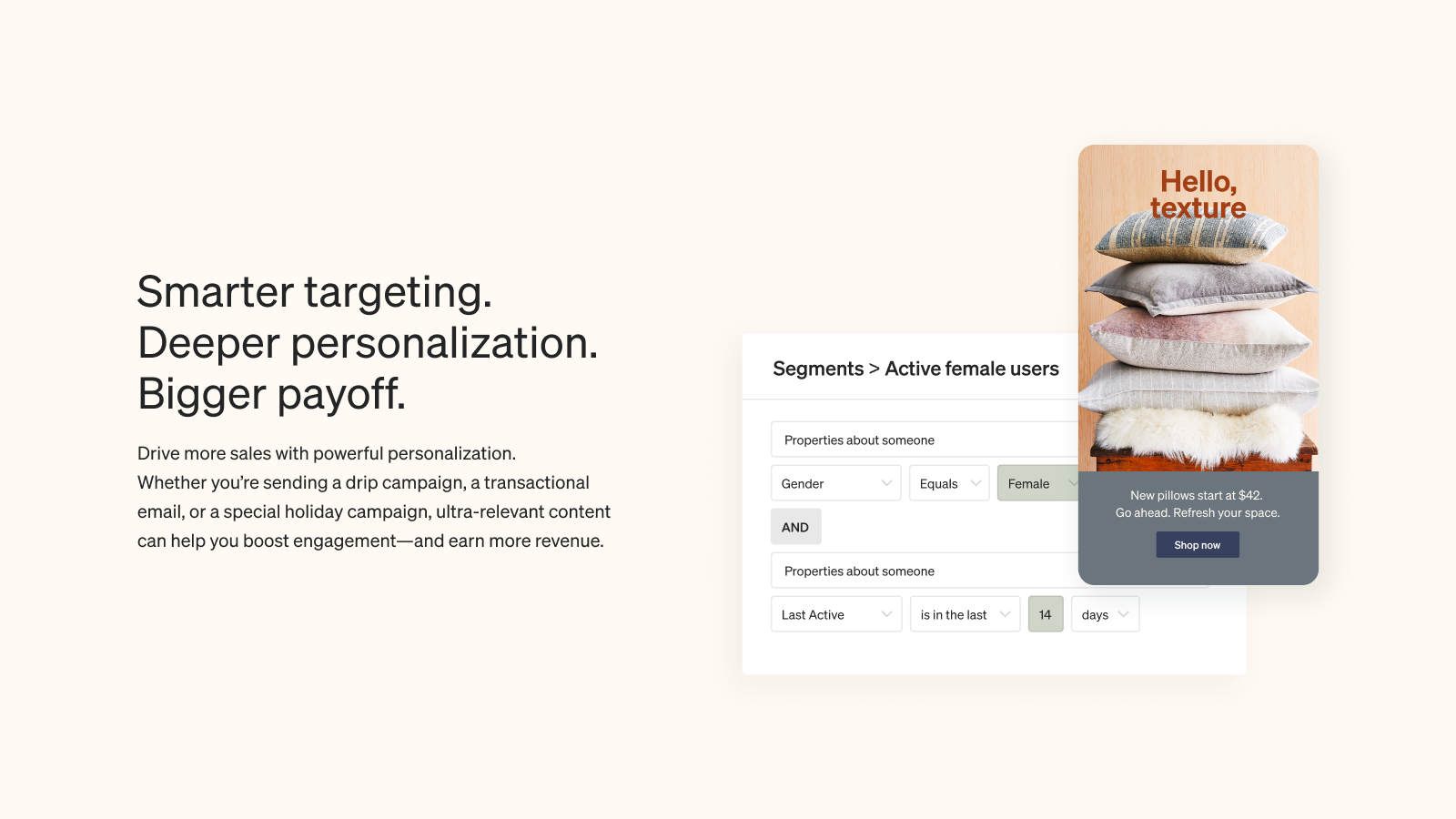
Klaviyo is a marketing automation platform that helps businesses to centralize and use every piece of their customer data. With Klaviyo, businesses can combine customer data with more than 350 native integrations to automate personalized email and SMS communications that make customers feel seen. From mom-and-pop shops to established companies, Klaviyo states businesses like Dermalogica, Living Proof, Solo Stove, Citizen Watches, and more than 143,000 other paying users leverage their platform…
N/A
Salesforce Marketing Cloud
Score 8.1 out of 10
N/A
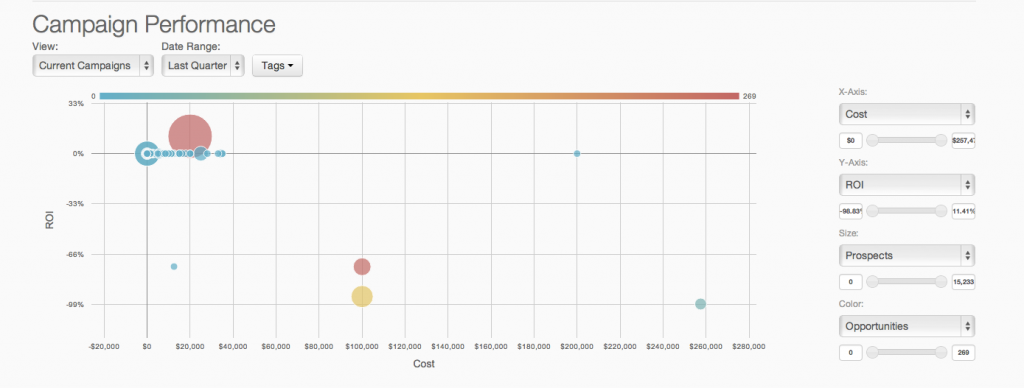
Marketing Cloud is an AI-powered, cloud-based digital marketing platform within the Salesforce Customer 360 ecosystem. Marketers can segment their audience, deliver personalized messages, track campaign performance, engage leads and accounts, and optimize strategies based on real-time insights.
$1,250
per month
Pricing
Klaviyo
Salesforce Marketing Cloud
Editions & Modules
No answers on this topic
Account Engagement
$1,250
per month
Engagement
$1,250
per month
Intelligence
$3,000
per month
Loyalty Management
$20,000
per month
Personalization
$100,000
per year
Data Cloud for Marketing
$108,000
per year
Offerings
Pricing Offerings
Klaviyo
Salesforce Marketing Cloud
Free Trial
Yes
Yes
Free/Freemium Version
Yes
No
Premium Consulting/Integration Services
No
No
Entry-level Setup Fee
No setup fee
No setup fee
Additional Details
Paid plans start at $20/month and include:
251 - 500 contacts
5,000 monthly email sends
150 SMS/MMS sending credits
Applicable SMS carrier fees
Mobile push notifications (free beta)
Email and chat support
Additional contacts, email and text sending credits, and service plans available to meet the needs of any size business.
View all of our pricing and estimate your total cost of ownership at klaviyo.com/pricing
—
More Pricing Information
Community Pulse
Klaviyo
Salesforce Marketing Cloud
Considered Both Products
Klaviyo
Verified User
Anonymous
Chose Klaviyo
We have not really evaluated other offerings outside of Klaviyo because I understand Klaviyo to be best in class for our use case. I think it has the best integrations out there. We do use other platforms for SMS and customer reviews (Which I know are solutions that Klaviyo …
Klaviyo is more robust that Constant Contact and Aweber, yet no less easy to use. It's also every bit as feature-rich as Active Campaign, but easier to use. (in my opinion) They're customer support isn't as good as Constant Contacts, but the tradeoff is a more sophisticated ESP …
For ecommerce, MailChimp and Constant Contact do not compare with Klaviyo. While their builders are not different, and the ability to create pleasing emails are similar, the targeting, segmentation, and data available are worlds apart. That said, I have not used MailChimp or …
We evaluated MailChimp and Salesforce Marketing Cloud. MailChimp was too basic at the time and didn’t scale well. Salesforce was overly complex, required a large team, and was costly to integrate and manage daily. Klaviyo stood out for its ease of setup, user-friendly …
We used Mailchimp to start out, and it is great for a small customer base but as our customer base grew we needed more power and Klaviyo had it. Including so many different automated flows and integrations to other apps and a/b testing and more. I would still recommend …
MailChimp was adequate for basic email marketing, but Klaviyo offers a far superior experience with its advanced segmentation, automated flows, and deep integration with Shopify. Klaviyo’s behavioral data analysis and A/B testing provide more precise targeting, while its robust …
Klaviyo has better custom options as well as better dynamic content. Not just the Klaviyo works flawlessly in integration with Shopify which is a huge plus.
Moreover it allows me to actually use the custom html features unlike other products where I need to have full …
At the time we used Attentive, Klaviyo did not have an SMS product. Attentive was very difficult to use, and provided little to no detailed reporting/analytics. It was very expensive, and had no integration with our email customers. They only provided us a shared short code, …
Klaviyo is the #1 email platform of choice for ecommerce. It out ranks every competitor. It is worth paying a little extra because you know you are providing your customers with the best experience and equipping your business for success. Email should be something you invest in …
Mailchimp is absolutely nothing compared to Klaviyo. Klaviyo's interface and functionality are far superior, and the types of emails and data analytic features are what have kept me a customer of Klaviyo for years. I am grateful for the benefit that Klaviyo has had for my …
Klaviyo provides much more insight into customer data than other email marketing software. For this reason, they are much stronger for e-commerce businesses as the data it provides is very beneficial for e-commerce businesses.
Mailchimp was used early in the business when we didn't have as many customers and weren't segmenting. We've used Yotpo for loyalty, reviews, and, most recently, SMS. We have yet to try Klaviyo reviews or SMS, but it would be nice to have all of these items in one suite.
A different marketing manager used mailchimp and omnisend and she is no longer with the company to ask. Emotive terrible to work with and Klaviyo was incredible to work with after them. It has made a huge difference having SMS and email in one place.
The comparison of Mailchimp to Klaviyo is that Mailchimp is a very simple email platform that is good for small businesses that are just getting started, while Klaviyo is a more in-depth email marketing platform that is great for businesses looking to grow and succeed in email …
As I explained, it was superior to MailChimp for sure. Attentive had more SMS features, but Klaviyo does what I need for SMS, and the fact that it has email & SMS in a single platform, with the ability to create campaigns and flows that use both, makes it a win.
Klaviyo doesn't necessarily need data architects or engineers to support or tie the data together. Salesforce Marketing Cloud typically requires a partner, data architect and/or someone who knows SQL. The email templates and help documentation are extremely easy to use and …
Mailchimp is super outdated, and for a while there they lost their integration with Shopify. Attentive started out with only being a SMS platform, not email. So because of that, we did not want to migrate everything over to Attentive once they launched email since everything …
I have worked with all three providers across different businesses and seen the benefit of each one in different ways. It is good that Salesforce Marketing Cloud connects well with salesforce as a sales management CRM. Hubspot is a lot. more user friendly of an interface and …
I find the data stored in the database is very much cleansed and hence the overall decision making process improves. Also the customised emails, digital marketing features stacks the Salesforce Marketing Cloud way above others
We use Salesforce Marketing Cloud for lead management, generating reports, tracking customer and dealer information, inputting orders, and more. I prefer HubSpot for email marketing and automation because it is easier to use and the emails are designed much better. We …
I think that all of the marketing platforms I have evaluated and used in the past serve different markets and purposes. Salesforce Marketing Cloud was more palatable to our team because of our existing tech stack where we had Salesforce CRM already deployed and in use. Compared …
Hubspot is more user friendly, more intuitive, and has functionality built in from the start that allows you to get things off the ground faster than SFMC. I use SFMC because that is the current platform at my employer.
Mailchimp is great for simple email use. It's straightforward and great for beginners in the email space. It does not offer nearly as much in the way of complexity as Salesforce Marketing Cloud does, so is limited with what it can do. Salesforce Marketing Cloud is much more …
It has more features and a fuller capacity for all things marketing. Pardot was clunky and lacked a good email builder. It wasn't my choice to select this software, but I see its value, and the team has benefitted from it. We hope they continue to improve functionality and …
Salesforce Marketing Cloud is a more comprehensive product than HubSpot Marketing Cloud. It integrates better with multiple channels, is a powerful audience builder, and is an efficient AI. However, Salesforce Marketing Cloud is also more expensive and requires Salesforce.com …
Salesforce Marketing Cloud stands out for its comprehensive features, scalability, and seamless integration capabilities. Compared to other platforms, its unified suite of tools for email, social media, mobile, and advertising enables streamlined cross-channel campaign …
Not to sound like I am completely against Salesforce Marketing Cloud, I believe HubSpot has worked alot on their marketing platform to simplify the interface along with keeping the rich functions a marketing platform would want. Campaign monitor is a bit more basic, but perfect …
My previous organization used Pardot and also Mailchimp. Salesforce Marketing Cloud is more powerful than both of those tools and integrates more deeply with Salesforce CRM.
Overall, 80 percent of the features and boiler plate and standard across all these tools. Salesforce leads in integrations and global scalability. But lacks in User interface and ease of use.
Salesforce Marketing Cloud offers many opportunities for personalization and supports big data integration. It features powerful tools like SQL for data and AMPscript for email creation. If someone wants to master the platform, it might require some initial learning, which I …
We use these both in conjunction together now rather than rivals as the data that can be held in both does differ slightly and one platform email maker is slightly better so we do a lot of the creative in one platform and then have it link in and have all the data flow into the …
Salesforce Marketing Cloud is intuitive and does what it needs to do. The functions are easy to find, and the automation options work smoothly. You find an intuitive workspace in both HubSpot and Marketo Engage, and the options in these programs look similar to Salesforce Sales …
Pardot has a tighter integration with Salesforce CRM compared to Marketo. This allows for more seamless data transfer. MCAE has a slightly more user-friendly interface compared to Marketo, which can make it easier for non-technical users to navigate. From the cost perspective, …
Both products have a very similar approach on the Engagment part. At least at the time we used Hootsuite, it didn't had integration with Instagram, so that was a big win when we changed to Social Studio. Also, the automation tools of Social Studio were a great diferential in …
Salesforce Marketing Cloud stacks up well against Adobe Campaign and Sendinblue. I found it to be a more robust and feature-rich platform than Adobe Campaign and Sendinblue.
Salesforce is faster and has better and more logical visualisation. Salesforce is evolving and has more relevant products from one vendor. Salesforce proved its course to AI supported user activity. AI module exists in Salesforce Marketing Cloud Interaction Studio, sure will …
The breadth of the services and features Salesforce Marketing Cloud Interaction Studio offers stacks up against its competitors and makes it an ideal choice. The future scope of Salesforce Marketing Cloud Interaction Studio is more impressive than its alternatives and the past …
Klaviyo performs exceptionally well as a newsletter service, helping our tabletop gaming company educate customers, retailers, distributors, media, and press on our product offerings and events. It has significantly boosted sales by allowing us to provide targeted and engaging content. Klaviyo’s robust data reporting allows us to track newsletter attribution to Shopify sales, offering invaluable insights. Customer service is fantastic, always helpful and responsive. However, recurring bugs and glitches—such as issues with font size, color, text block sizes changing on their own, or text disappearing entirely and forcing you to restart a section—can be very frustrating, impacting the smoothness of the user experience. The gains far outweigh the downsides.
At least for us, what we noticed is the best use case is that it replaces the use of cloud teams, which has a more complex platform to navigate; since we are already using Salesforce, it was just more straightforward to allow the teams to continue to do that as opposed to giving them a new system. This also works for us because they are both selling the same product in different ways. Any team collaboration is where this product shines.
I have Integrated Klaviyo with my Website and with salesforce which works simultaneously. This integration is happened very easily as In klaviyo we have flows through which we can do automations and set webhook integration with no code activity.
Klaviyo helps me to measure the success of email campaigns.
Klaviyo helps me to automate the manual tasks with the helps Flows in it which is very easy to use as it has a very easy to understand user interface and no coding reuired.
At times the platform isn't as intuitive as you would like. Take the time to be onboarded and play around in the platform to get the hang of things. Utilize Klaviyo's resources and attend their live training sessions to help navigate the platform and implement best practices they recommend.
Can be pricey depending on company and email list.
Customization is limited at times. The brand font we utilized on all branded content wasn't available through Klaviyo. Previously we would have to go through the back end to implement our branded font, import our font, or create content on another platform to utilize our font.
Klaviyo is simply a great solution for e-com email marketing & customer relationship management:
User journey visibility: We can see our clients' customers on their individual user journeys (open email, site visits) to better understand and accommodate your customers.
Flow automation: Creating automated emails that follow up with new leads, those who abandoned carts, purchased.
Email design: So easy to use, and more friendly than some other visual builders that we've used.
Metrics visibility: We can see our clients' metrics very easily and adjust efforts accordingly.
We are happy with Pardot. It has made our jobs easier and installed some reporting functions that have increased our ROI with the company. We have worked hard to set-up the functions in Pardot and it has taken time, but paid off.
It's a decent platform with a user friendly interface, however it massively misses trust due to unsecured systems and support from customer service; support is a massive problem if you run a company and have a problem with the service that you can't fix. On the other side of the line, in our experience, there is no support or understanding which we haven't encountered with any other company we have done business online in the last decade.
You won't find another solution that has as many features as Salesforce Marketing Cloud Interaction Studio. We all know Salesforce, we all know how big they are and it's not for nothing... Their tools do most of the things you want, need and even imagine. Using it is complicated, but the usability is infinite.
Upgrades and timing of the upgrades were communicated well and planned during off hours for our work. If we did have a campaign scheduled during that time, it would kick-off after the system was back active. There were a few unplanned system down times, but it was a rare occurrence and those times were also short in duration.
Though the make up of MA apps is not built this way today, it would be nice to see them become more real-time. The integration between Salesforce and Pardot is not a true real-time integration. If I modify something in Salesforce, those changes are not automatically reflected in Pardot immediately. There is a delay of about 15 minutes before the systems sync. This delay, although not long, is less than ideal We would love the systems to be integrated real time such that changes are propagated from one system to the other immediately.
Their support is always quick and we have recurring meetings with our advisor. they were great when we first started at walking us through the platform and helping us understand how to do the overall setup. They also have a wide variety of articles that cover must issues in a very clear manner that will get you out of a predicament really fast.
They are really responsive and more than not solve the problem or give you insight to how you can manage the solution yourself. I do find however sometimes a long delay on the more complex issues when they need to loop in other departments. but overall a good experience with support
Training program is not very well established. There is very little documentations. More often than not it's in-person training. I wish there were more video tutorials so that somebody can learn the system quickly. Their documentation is very much like an RFP. Long and very technichal. They should definitly improve on this area.
Pardot's online training touches on all topics briefly and vaguely without much indepth exploration into how a final outcome could look, such as Nurturing Campaigns, Email templates, landing page templates, etc... The only true way to uncover Pardot's full capabilities is to have Front End design and coding experience. Without this key skill set, I would not recommend Pardot to another business.
Don't cut corners, do it right the first time, if you take your time to build everything the way you want it then it will run itself. The platform will help you increase revenue as long as you use the tools it provides. Don't be scared to ask questions, the support team will help you get to the next level
From an IT perspective, once you set up the Javascript beacon and start collecting data there is a waiting game. During this time you can start labeling your site actions which can be labor intensive for a single person, but you don't really have the final end-users on the platform yet. We did a lot of training so users were experienced, but it wasn't until they had their first tasks to accomplish that they started using the system and had questions. I'd recommend setting up some immediate goals for an end-user to start segmenting for the purpose of displaying message campaigns so you can jump start end-user action.
We used Mailchimp to start out, and it is great for a small customer base but as our customer base grew we needed more power and Klaviyo had it. Including so many different automated flows and integrations to other apps and a/b testing and more. I would still recommend Mailchimp if you have less than 5,000 contacts but anything over that you need Klaviyo.
We use Salesforce Marketing Cloud for lead management, generating reports, tracking customer and dealer information, inputting orders, and more. I prefer HubSpot for email marketing and automation because it is easier to use and the emails are designed much better. We currently use Salesforce and HubSpot, and we are very happy to have both, as they have different pros/cons.
Salesforce Marketing Cloud does a great job at what it is designed to do. There are several SaaS products in the Marketing Automation arena and SFMC is one of the top providers. There are several things it does well, such as email marketing and automation, leads generation/segmentation/qualification, and reporting/analytics. There are a few areas of improvement when it comes to the product and they surround legacy systems and architecture, outdated UI/UX, as well as targeting data in the activity logs for reporting and segmentation.
we have grown our revenue significantly without increasing our spend. This is critical.
retention rate has gone up tremendously with specific campaigns and audience targeting
would love to personalize more but we are a small team and struggle to do as much as we could. It would be great to have an account manager who could make account based recommendations