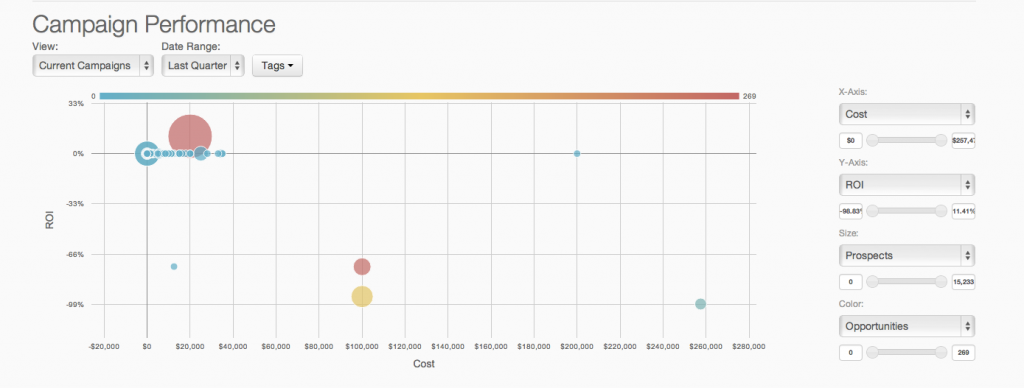
Mailchimp is an email marketing and marketing automation platform. Beyond just tracking how campaigns perform, Mailchimp takes it a step further by analyzing data from over half a billion emails to show why campaigns perform, driving informed decisions.
$0
Salesforce Marketing Cloud
Score 8.1 out of 10
N/A
Marketing Cloud is an AI-powered, cloud-based digital marketing platform within the Salesforce Customer 360 ecosystem. Marketers can segment their audience, deliver personalized messages, track campaign performance, engage leads and accounts, and optimize strategies based on real-time insights.
$1,250
per month
Pricing
Intuit Mailchimp
Salesforce Marketing Cloud
Editions & Modules
Free
$0
Essentials
starts at $13
per month
Standard
starts at $20
per month
Premium
starts at $350
per month
Account Engagement
$1,250
per month
Engagement
$1,250
per month
Intelligence
$3,000
per month
Loyalty Management
$20,000
per month
Personalization
$100,000
per year
Data Cloud for Marketing
$108,000
per year
Offerings
Pricing Offerings
Intuit Mailchimp
Salesforce Marketing Cloud
Free Trial
Yes
Yes
Free/Freemium Version
Yes
No
Premium Consulting/Integration Services
No
No
Entry-level Setup Fee
No setup fee
No setup fee
Additional Details
—
—
More Pricing Information
Community Pulse
Intuit Mailchimp
Salesforce Marketing Cloud
Considered Both Products
Intuit Mailchimp
Verified User
Anonymous
Chose Intuit Mailchimp
First, the product has to do what it's supposed to do; and second, it has to be easy to use. MailChimp does well in both categories. I have found that most of the big name competitors certainly handle the first one but fall a bit short on the usability side of it.
Verified User
Anonymous
Chose Intuit Mailchimp
We have used several email marketing tools. Without a doubt a big plus to give to Mailchimp is how easy it is to use and how great their free features are. As the business grew, we continued using Mailchimp, but were so let down by how their pricing works, how barebones the …
Intuit Mailchimp is much more intuitive and easier to navigate than Constant Contact. We also had issues with Constant Contact's link clicks and reporting features, which were giving inaccurate information. Accurate reporting is incredibly important to us, and that was a big …
I have used a lot of email marketing tools over the years and Intuit Mailchimp is one that I keep going back to, it simple and easy to use, no messing around and it does what it says one tin.
I've had several clients switch to Intuit Mailchimp from Constant Contact. I think the features and functions of Intuit Mailchimp proved to be better and the value to be better.
Mailchimp has a much better looking email design compared to HubSpot and Vertical Response. It seems to automatically optimize email sections for different devices and viewing/testing emails before they go out seems to be a much cleaner process for sending tests to team members …
Blackbaud Raiser's Edge NXT is our primary CRM for managing our constituent database, maintaining donor records, and processing donations. It includes communication and email components as well, but they don't seem as user-friendly or robust as Mailchimp. Therefore, we have …
We chose Intuit Mailchimp over competing solutions because we found their free tier more generous, which allowed us to get started easier. Also compared to other solutions we found their drag and drop email builder to offer a much better experience and easier UI. We also liked …
First consideration is the cost, the value is affordable for a small size company like us. The second is the simplicity of how Mailchimp organize the functionalities on the platform. HubSpot has too much burdensome modules would overwhelm a small size company. We thought about …
Our previous in-house system was slow and cumbersome to use, requiring more manual work to build content. Intuit Mailchimp handles text, pictures and links much more efficiently, meaning that we can quickly paste in format into templated boxes, then define who we wish to send …
Although Mailchimp's pricing has increased recently, we opted to stick with them after evaluating these and a few other platforms because, overall, their combination of features and pricing is superior. Additionally, we must consider the time and effort required to migrate to a …
I don't think they are comparable; we use Google Ads to put our website at the top of the list when someone googles certain words. We use meta business to manage our social media. Google aims to gain customers, while Mailchimp is used to interact with both existing and new …
Intuit Mailchimp gives a 360" CRM experience and gives the possibility to manage social media, texts, pushes, emails, and other interactions in one place. It is really handy and offers numerous possibilities for creating complex marketing campaigns within a single platform. …
I thought both worked similar, but I thought Intuit Mailchimp was easter to use from the get go, and I thought Constant Contact was too "templated" in both appearance and style - that I feel like I have more control in Intuit Mailchimp.
We have always used Intuit Mailchimp in regards to sending out our email campaigns. We do use SMS Broadcast for our text campaigns however they do not offer beyond sending SMS's, which Intuit Mailchimp does allow for both.
I had meetings with representatives of those two companies but, even though they are aimed for internal comms, they were less useful and complex than Intuit Mailchimp which gave us more possibilities i.e. regarding the customization and reporting. So you are on a good way to …
I have worked with all three providers across different businesses and seen the benefit of each one in different ways. It is good that Salesforce Marketing Cloud connects well with salesforce as a sales management CRM. Hubspot is a lot. more user friendly of an interface and …
I find the data stored in the database is very much cleansed and hence the overall decision making process improves. Also the customised emails, digital marketing features stacks the Salesforce Marketing Cloud way above others
We use Salesforce Marketing Cloud for lead management, generating reports, tracking customer and dealer information, inputting orders, and more. I prefer HubSpot for email marketing and automation because it is easier to use and the emails are designed much better. We …
I think that all of the marketing platforms I have evaluated and used in the past serve different markets and purposes. Salesforce Marketing Cloud was more palatable to our team because of our existing tech stack where we had Salesforce CRM already deployed and in use. Compared …
Hubspot is more user friendly, more intuitive, and has functionality built in from the start that allows you to get things off the ground faster than SFMC. I use SFMC because that is the current platform at my employer.
Mailchimp is great for simple email use. It's straightforward and great for beginners in the email space. It does not offer nearly as much in the way of complexity as Salesforce Marketing Cloud does, so is limited with what it can do. Salesforce Marketing Cloud is much more …
It has more features and a fuller capacity for all things marketing. Pardot was clunky and lacked a good email builder. It wasn't my choice to select this software, but I see its value, and the team has benefitted from it. We hope they continue to improve functionality and …
Salesforce Marketing Cloud is a more comprehensive product than HubSpot Marketing Cloud. It integrates better with multiple channels, is a powerful audience builder, and is an efficient AI. However, Salesforce Marketing Cloud is also more expensive and requires Salesforce.com …
Salesforce Marketing Cloud stands out for its comprehensive features, scalability, and seamless integration capabilities. Compared to other platforms, its unified suite of tools for email, social media, mobile, and advertising enables streamlined cross-channel campaign …
Not to sound like I am completely against Salesforce Marketing Cloud, I believe HubSpot has worked alot on their marketing platform to simplify the interface along with keeping the rich functions a marketing platform would want. Campaign monitor is a bit more basic, but perfect …
My previous organization used Pardot and also Mailchimp. Salesforce Marketing Cloud is more powerful than both of those tools and integrates more deeply with Salesforce CRM.
Overall, 80 percent of the features and boiler plate and standard across all these tools. Salesforce leads in integrations and global scalability. But lacks in User interface and ease of use.
Salesforce Marketing Cloud offers many opportunities for personalization and supports big data integration. It features powerful tools like SQL for data and AMPscript for email creation. If someone wants to master the platform, it might require some initial learning, which I …
We use these both in conjunction together now rather than rivals as the data that can be held in both does differ slightly and one platform email maker is slightly better so we do a lot of the creative in one platform and then have it link in and have all the data flow into the …
Salesforce Marketing Cloud is intuitive and does what it needs to do. The functions are easy to find, and the automation options work smoothly. You find an intuitive workspace in both HubSpot and Marketo Engage, and the options in these programs look similar to Salesforce Sales …
Pardot has a tighter integration with Salesforce CRM compared to Marketo. This allows for more seamless data transfer. MCAE has a slightly more user-friendly interface compared to Marketo, which can make it easier for non-technical users to navigate. From the cost perspective, …
Both products have a very similar approach on the Engagment part. At least at the time we used Hootsuite, it didn't had integration with Instagram, so that was a big win when we changed to Social Studio. Also, the automation tools of Social Studio were a great diferential in …
Salesforce Marketing Cloud stacks up well against Adobe Campaign and Sendinblue. I found it to be a more robust and feature-rich platform than Adobe Campaign and Sendinblue.
Salesforce is faster and has better and more logical visualisation. Salesforce is evolving and has more relevant products from one vendor. Salesforce proved its course to AI supported user activity. AI module exists in Salesforce Marketing Cloud Interaction Studio, sure will …
The breadth of the services and features Salesforce Marketing Cloud Interaction Studio offers stacks up against its competitors and makes it an ideal choice. The future scope of Salesforce Marketing Cloud Interaction Studio is more impressive than its alternatives and the past …
I loved Mailchimp 10 years ago, and as a long-time user, I appreciate working with the brand I've been attached to for so many years. It still works well with regular email campaigns and with automation. However, if your email audience is constantly growing and you have a limited budget, it may be wise to explore the more affordable options.
At least for us, what we noticed is the best use case is that it replaces the use of cloud teams, which has a more complex platform to navigate; since we are already using Salesforce, it was just more straightforward to allow the teams to continue to do that as opposed to giving them a new system. This also works for us because they are both selling the same product in different ways. Any team collaboration is where this product shines.
Mailchimp allows you to manage your mailing list really well. You can subscribe people, unsubscribe people manage the mailing list directly into segments, and what not.
Mailchimp has features where you can create campaigns based on your mailing lists and send out newsletters to your subscribers based on a multitude of parameters that you can setup. Such as send email daily, weekly, monthly and they also have event based mails that you can send out.
Mailchimp also has a feature where you can design your emails. The look and aesthetics are very important when sending emails to your subscribers and all those needs are addressed here.
The interface remains a cluttered, non-intuitive mess. That's true from the haphazard way features are organized to the actual email layout.
Analytics have never been a priority, and I don't see that changing with Intuit's new ownership. I'm very frustrated over the limited choices for reporting, even when using third-party solutions. If I needed that function, I would not use MailChimp.
I would love to develop a workflow screen that lets me focus on the things that I use all the time. Customizing the interface where the content actually goes into the software would help.
I never understood why we couldn't import a document into a MC template. At best, we're spending time copying-and-pasting from one app into MC.
We love the product. One thing we haven't mentioned yet is the human element. Recently, MailChimp re-structured their plans/pricing based on the feedback they had received. They listened to a pain their users were experiencing, then strategized a solution, and implemented it fairly. The updated pricing strategy was intended to save subscribers money, and they did a great job of communicating it to their users. I would be surprised if anyone reacted negatively to the change.
We are happy with Pardot. It has made our jobs easier and installed some reporting functions that have increased our ROI with the company. We have worked hard to set-up the functions in Pardot and it has taken time, but paid off.
I think Mailchimp enables companies to cater to their customers without requiring direct interaction with them. A simple email can convey a great deal of information. The SMS feature can give a brief link with a sentence to show promotional offers. I think that best fits with the upcoming generation; I don't always want to read a long email with lots of pictures. I think Mailchimp is easy to navigate and has many valuable features.
You won't find another solution that has as many features as Salesforce Marketing Cloud Interaction Studio. We all know Salesforce, we all know how big they are and it's not for nothing... Their tools do most of the things you want, need and even imagine. Using it is complicated, but the usability is infinite.
I have, in the 4+ years that I've used Mailchimp, never seen an issue that restricted the use of their software/tools. I don't know of a single time when they're system crashed or went down. I could be wrong, but I honestly haven't experienced any issues with outages, errors or unplanned downtime
Upgrades and timing of the upgrades were communicated well and planned during off hours for our work. If we did have a campaign scheduled during that time, it would kick-off after the system was back active. There were a few unplanned system down times, but it was a rare occurrence and those times were also short in duration.
I haven't noticed any slow speeds from Mailchimp or their tools. I think the landing pages load quickly and look nice. The email reports and editing operates smoothly and doesn't take time to load. Additionally, when I use Mailchimp in conjunction with Zapier + Hubspot I don't notice any drag between any of these tools
Though the make up of MA apps is not built this way today, it would be nice to see them become more real-time. The integration between Salesforce and Pardot is not a true real-time integration. If I modify something in Salesforce, those changes are not automatically reflected in Pardot immediately. There is a delay of about 15 minutes before the systems sync. This delay, although not long, is less than ideal We would love the systems to be integrated real time such that changes are propagated from one system to the other immediately.
Any time we needed their help or support they responded promptly, friendly, and straightforwardly. It's a great feature to have multi-language support as we are a diverse team, and anyone can reach out to receive help. We've always solved our inquires
They are really responsive and more than not solve the problem or give you insight to how you can manage the solution yourself. I do find however sometimes a long delay on the more complex issues when they need to loop in other departments. but overall a good experience with support
Training program is not very well established. There is very little documentations. More often than not it's in-person training. I wish there were more video tutorials so that somebody can learn the system quickly. Their documentation is very much like an RFP. Long and very technichal. They should definitly improve on this area.
Pardot's online training touches on all topics briefly and vaguely without much indepth exploration into how a final outcome could look, such as Nurturing Campaigns, Email templates, landing page templates, etc... The only true way to uncover Pardot's full capabilities is to have Front End design and coding experience. Without this key skill set, I would not recommend Pardot to another business.
I am little satisfied with the MailChimp implementation process, since although it has been a bit complicated and we have had various complications that tried to affect our performance, with a little general effort, we take full advantage and currently It is out main marketing and advertising campaign platform.
From an IT perspective, once you set up the Javascript beacon and start collecting data there is a waiting game. During this time you can start labeling your site actions which can be labor intensive for a single person, but you don't really have the final end-users on the platform yet. We did a lot of training so users were experienced, but it wasn't until they had their first tasks to accomplish that they started using the system and had questions. I'd recommend setting up some immediate goals for an end-user to start segmenting for the purpose of displaying message campaigns so you can jump start end-user action.
We chose Intuit Mailchimp over competing solutions because we found their free tier more generous, which allowed us to get started easier. Also compared to other solutions we found their drag and drop email builder to offer a much better experience and easier UI. We also liked their paid features and could see that we would be able to use Intuit Mailchimp for a long time and not need to migrate to another solution.
We use Salesforce Marketing Cloud for lead management, generating reports, tracking customer and dealer information, inputting orders, and more. I prefer HubSpot for email marketing and automation because it is easier to use and the emails are designed much better. We currently use Salesforce and HubSpot, and we are very happy to have both, as they have different pros/cons.
Mailchimp over the years I've used it has grown in leaps and bounds. They have added so many additional features than were previously available. They are truly an all-in-one marketing platform now. If you're a small operation and just want to add email to your marketing efforts, they're there for you. If you're a larger operation and want to start sending postcard advertisements, they can do that. If you'd good with that and want to kick up your marketing by going social, you can do that on their platform. They are truly able to be as small as you need, but also get quite large in whatever it is you'd like to do through their system.
Salesforce Marketing Cloud does a great job at what it is designed to do. There are several SaaS products in the Marketing Automation arena and SFMC is one of the top providers. There are several things it does well, such as email marketing and automation, leads generation/segmentation/qualification, and reporting/analytics. There are a few areas of improvement when it comes to the product and they surround legacy systems and architecture, outdated UI/UX, as well as targeting data in the activity logs for reporting and segmentation.
One of my retail web store clients was sending out email specials and notices about once a month. After clicking the send button, we would watch Google Analytics and the current site users would light up immediately. Often, the current site visitors would pop up to 20, 30 or more after the email was sent. On a normal day, seeing 1 or 2 online users would be OK.
Pretty much in all cases, we could see an uptick in positive activity after sending out a Intuit Mailchimp email to a list.