Adobe Test and Target is an A/B, multi-variate testing platform which Adobe acquired as part of the Omniture platform in 2009. It is now part of the Adobe Marketing Cloud. It offers tight integration with Adobe analytics and content management products.
N/A
Optimizely Web Experimentation
Score 8.7 out of 10
N/A
Whether launching a first test or scaling a sophisticated experimentation program, Optimizely Web Experimentation aims to deliver the insights needed to craft high-performing digital experiences that drive engagement, increase conversions, and accelerate growth.
N/A
Pricing
Adobe Target
Optimizely Web Experimentation
Editions & Modules
No answers on this topic
No answers on this topic
Offerings
Pricing Offerings
Adobe Target
Optimizely Web Experimentation
Free Trial
No
Yes
Free/Freemium Version
No
No
Premium Consulting/Integration Services
No
No
Entry-level Setup Fee
No setup fee
Optional
Additional Details
—
—
More Pricing Information
Community Pulse
Adobe Target
Optimizely Web Experimentation
Features
Adobe Target
Optimizely Web Experimentation
Testing and Experimentation
Comparison of Testing and Experimentation features of Product A and Product B
Adobe Target
8.6
Ratings
5% above category average
Optimizely Web Experimentation
8.0
Ratings
3% below category average
a/b experiment testing
10.00 Ratings
9.00 Ratings
Split URL testing
8.50 Ratings
8.50 Ratings
Multivariate testing
9.50 Ratings
8.40 Ratings
Multi-page/funnel testing
8.00 Ratings
7.90 Ratings
Cross-browser testing
8.60 Ratings
8.10 Ratings
Mobile app testing
8.60 Ratings
8.00 Ratings
Test significance
7.40 Ratings
8.40 Ratings
Visual / WYSIWYG editor
8.50 Ratings
8.10 Ratings
Advanced code editor
8.00 Ratings
8.00 Ratings
Page surveys
9.00 Ratings
6.20 Ratings
Visitor recordings
8.50 Ratings
8.40 Ratings
Preview mode
9.50 Ratings
7.60 Ratings
Test duration calculator
9.50 Ratings
7.90 Ratings
Experiment scheduler
9.00 Ratings
8.20 Ratings
Experiment workflow and approval
7.90 Ratings
7.80 Ratings
Dynamic experiment activation
8.00 Ratings
7.50 Ratings
Client-side tests
9.50 Ratings
7.80 Ratings
Server-side tests
8.00 Ratings
7.20 Ratings
Mutually exclusive tests
7.50 Ratings
8.10 Ratings
Audience Segmentation & Targeting
Comparison of Audience Segmentation & Targeting features of Product A and Product B
Adobe Target
8.5
Ratings
0% below category average
Optimizely Web Experimentation
8.2
Ratings
4% below category average
Standard visitor segmentation
8.50 Ratings
8.40 Ratings
Behavioral visitor segmentation
8.00 Ratings
7.70 Ratings
Traffic allocation control
8.50 Ratings
9.10 Ratings
Website personalization
9.00 Ratings
7.80 Ratings
Results and Analysis
Comparison of Results and Analysis features of Product A and Product B
We recommend this application because it allows us to segment and track the traffic of our domain under an analysis of their behavior, ranging from counting the number of clicks they make on a single element to the most complete action within our page in real time.
I think it can serve the whole spectrum of experiences from people who are just getting used to web experimentation. It's really easy to pick up and use. If you're more experienced then it works well because it just gets out of the way and lets you really focus on the experimentation side of things. So yeah, strongly recommend. I think it is well suited both to small businesses and large enterprises as well. I think it's got a really low barrier to entry. It's very easy to integrate on your website and get results quickly. Likewise, if you are a big business, it's incrementally adoptable, so you can start out with one component of optimizing and you can build there and start to build in things like data CMS to augment experimentation as well. So it's got a really strong a pathway to grow your MarTech platform if you're a small company or a big company.
The Platform contains drag-and-drop editor options for creating variations, which ease the A/B tests process, as it does not require any coding or development resources.
Establishing it is so simple that even a non-technical person can do it perfectly.
It provides real-time results and analytics with robust dashboard access through which you can quickly analyze how different variations perform. With this, your team can easily make data-driven decisions Fastly.
There should be some more clarity around what makes a test significant. While this can be decided by the client themselves, some direction from the tool would be helpful.
Also, if there was an easier way to organize campaigns and search for them it would be helpful. Right now there is just a long list of campaigns and you have to rely on search to find a specific campaign. What if you don't know the name of the test?
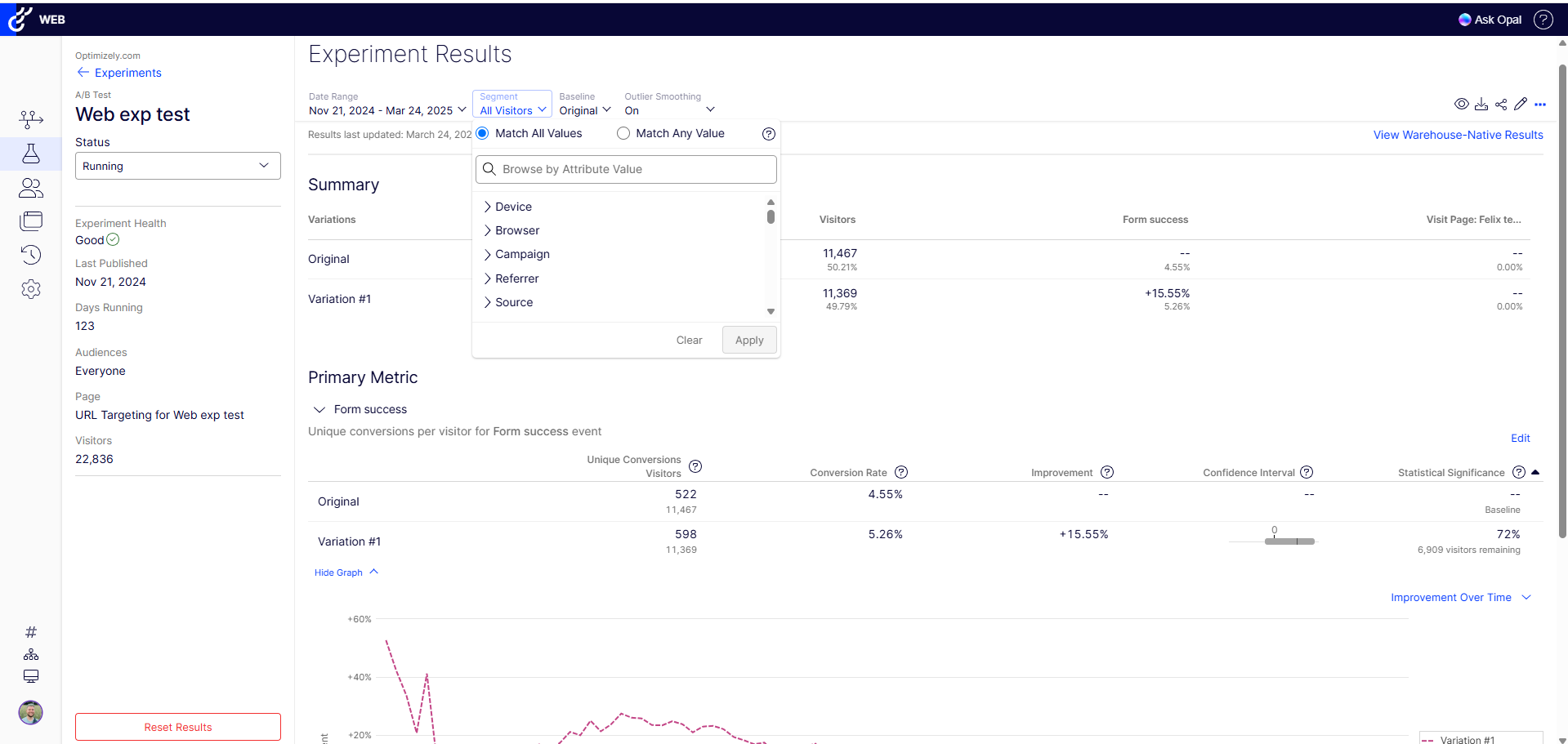
The results view is dense and difficult to package easily for leadership, and when filtering by segment it's hard to read comparative outcomes without clearing or swapping filters
The organization of experiments and statuses is a cluttered list and the search is limited in use - would love to see that improve with time
There are so many other MarTech products out there, would love to see more dedicated integrations so we don't have to invest in something like Zapier or Tray to build hacky automations
Once you get started with your testing program, you realize that it is necessary to continue. You must keep optimizing in order to remain a vital competitor in today's marketing world. Even if you're not using Test & Target or any other user experience testing software, you ought to be performing comparison tests on your own, simply by routing your audience to different experiences and quantifying the aggregate of the results.
Because it's an incredible and essential tool for my line of work as a conversion optimization specialist. Really couldn't do my job nearly as effectively without it. It's paid for itself many times over and I feel like I'm only beginning to unlock the tools potential.
The recent UI update is a complete mess. It is difficult to navigate and find features that previously existed. The reactiveness of the page depending on window size is also ridiculous and it is absurd that depending on how large your window is, entire columns of functions will disappear with no indication that they are missing. The usability of the tool has fallen off a cliff.
Optimizely Web Experimentation's visual editor is handy for non-technical or quick iterative testing. When it comes to content changes it's as easy as going into wordpress, clicking around, and then seeing your changes live--what you see is what you get. The preview and approval process for sharing built experiments is also handy for sharing experiments across teams for QA purposes or otherwise.
I would rate Optimizely Web Experimentation's availability as a 10 out of 10. The software is reliable and does not experience any application errors or unplanned outages. Additionally, the customer service and technical support teams are always available to help with any issues or questions.
I would rate Optimizely Web Experimentation's performance as a 9 out of 10. Pages load quickly, reports are complete in a reasonable time frame, and the software does not slow down any other software or systems that it integrates with. Additionally, the customer service and technical support teams are always available to help with any issues or questions.
On several occasions, we have had the need to ask for help from the Adobe Target support team, and I must say that they have provided us with an excellent experience, as they take care of solving the problems quickly and with high precision
They always are quick to respond, and are so friendly and helpful. They always answer the phone right away. And [they are] always willing to not only help you with your problem, but if you need ideas they have suggestions as well.
The instructor that came to train us was awesome and this training was very useful. I would recommend it for anyone who is going to be using this software. I only mark it lower because it is an added expense to an already expensive product, and a lot of the training covered the "Target" portion of the software (which again, we didn't use)
The training was very easy to understand, however it would have been more useful to my development team than me. It was also primarily over-the-phone, which is never as easy to follow as in-person. We ended up scheduling and paying for an in-person training session to supplement the online/phone training because it wasn't helpful enough.
The tool itself is not very difficult to use so training was not very useful in my opinion. It did not also account for success events more complex than a click (which my company being ecommerce is looking to examine more than a mere click).
Implement using a global mBox on the page so you can change any and everything over the traditional method. Traditional method is good if you do not have technical web dev resources, do not know Javascript/jQuery, or you have money to blow on mBox calls. Global deployment reduces mBox calls and allows you to touch many parts of the page easily. A lot more customizable
The implementation through the tag management system took a bit of trial and error at first, mostly due to the asynchronous nature of the TMS. We had to manipulate the implementation to assure that the Optimizely code was written to the page at the right time to allow the experiment content load in the browser without showing any of the original content first. We also needed to make some adjustments to the TMS code to get the integration with Site Catalyst timed appropriately.
For us, the decision was very straightforward. We chose to invest in the Adobe stack and utilize tools that are developed to integrate together and complement each other. Ex: Adobe Target 'A4T' integration within Adobe Analytics. Optimizely appears to be a great tool, but for us aligning with the Adobe suite, ensuring that future product enhancements and tools would work well together was a very important key factor in our decision
The ability to do A/B testing in Optimizely along with the associated statistical modelling and audience segmentation means it is a much better solution than using something like Google Analytics were a lot more effort is required to identify and isolate the specific data you need to confidently make changes
It's incredibly flexible and adapts well to organizations of all sizes, whether you’re running a single site or managing multiple departments and platforms. The ability to deploy experiments seamlessly across different environments is a huge plus, especially for growing businesses. While it’s highly scalable, the last point would depend on the right team leveraging its full potential.
This is something we've been working to improve on, as far as how we're calculating and tracking this, but Target has had a substantial ROI on our business.
I will say specific to our efforts, we could have probably done similar work if not the same work using a different testing tool (Optimizely for example), but Target has been good for us.