Adobe Dynamic Tag Management (DTM) was a tool used by marketers to manage tags, and for collecting and distributing data across digital marketing systems. Adobe DTM is a legacy, and it will not receive feature updates. Adobe invites users to upgrade to Launch on the Adobe Experience Platform.
N/A
Tealium Customer Data Hub
Score 8.2 out of 10
Enterprise companies (1,001+ employees)
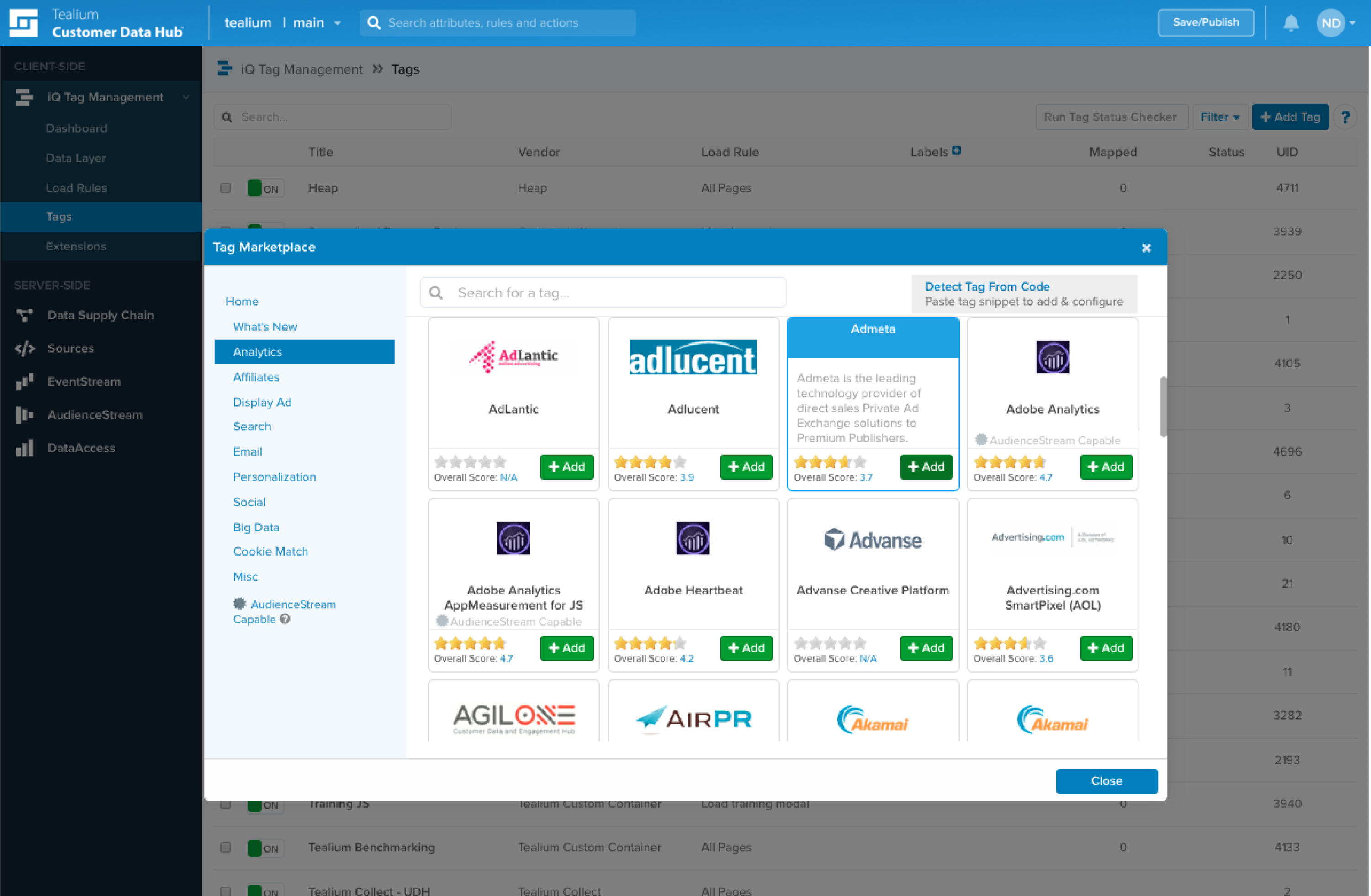
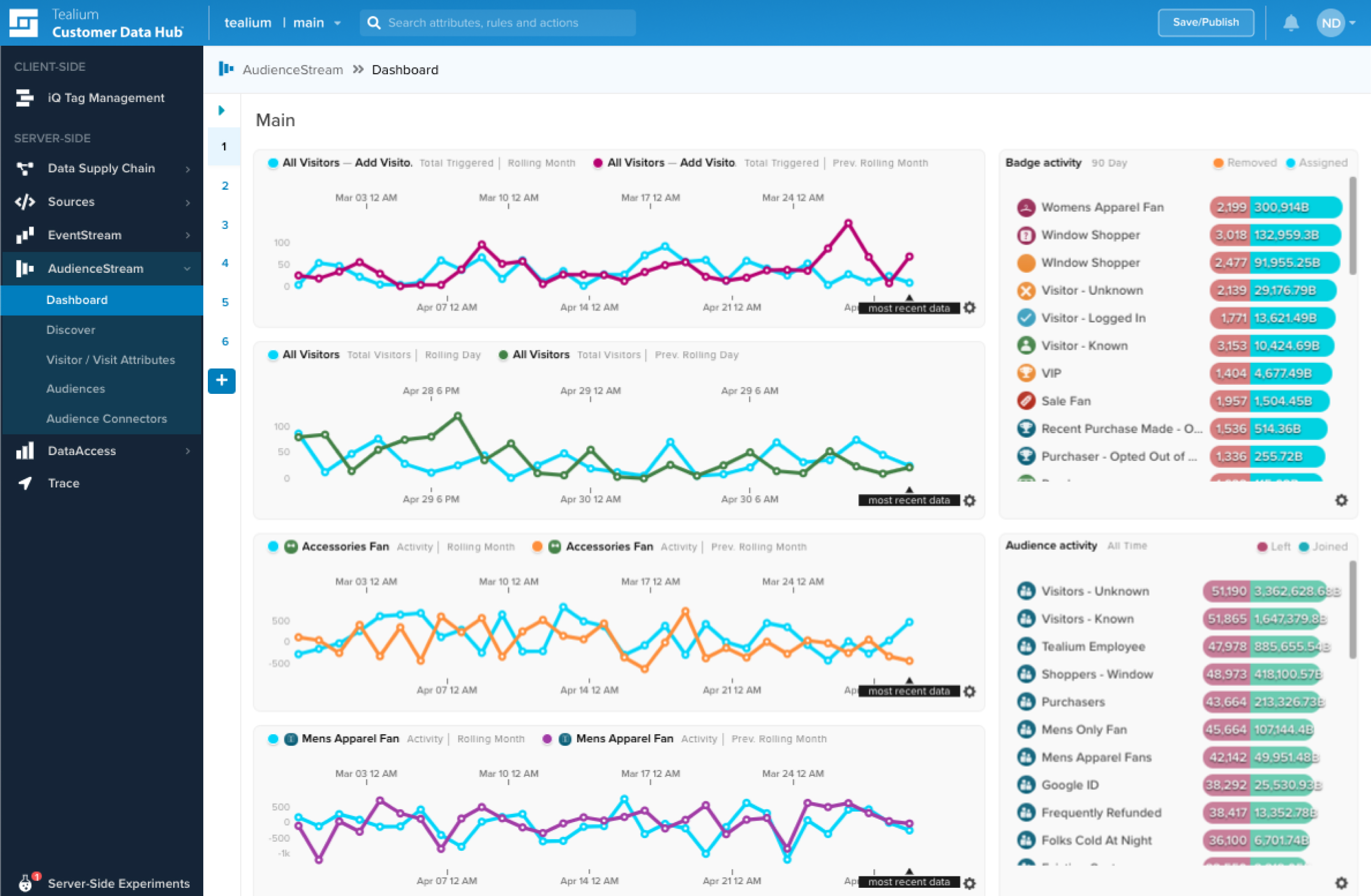
The Tealium Customer Data Hub powers capabilities across the data supply chain. Tealium universally collects customer data from any source including; websites, mobile applications, devices, kiosks, servers, and files. Data collected is then standardized in the data layer, which drives usage of data for customer engagement and analysis.
Google Tag Manager is free software from Google that allows you to deploy many different types of tags quickly and easily without utilizing web developers. Dynamic Tag Management, on the other hand, can only be acquired if you purchase an adobe solution. It too allows you to …
Adobe DTM provides a more secure data analytics solution. It is customized and best used on large scale deployments of websites with pages 10,000+. The Adobe Analytics tool, once learned, is very easy to use and provides more robust, customized graphics and ability to export …
The one thing GTM has over DTM is that there are a bunch of hosted pixels by companies like Facebook. Otherwise, it's incredibly inferior. The DTM UI is easier, more intuitive, and more comprehensible. Debugging is easier as well, and the triggers are better defined in DTM. …
Since we are using it almost exclusively with the implementation of Adobe Media Optimizer, we have not considered using a different tag management software.
All of these products they have the final usage of these technologies is all of the times around using Insider. For example, you have a CDP capability, but in order to activate to their own digital channels like WhatsApp or SMS or personalization on site, and you have other …
SalesForce and Adobe are too monolithic and not flexible enough. Segment is a strong competitor for the Tealium Customer Data Hub and has an excellent UI.
Tealium Customer Data Hub focus on security and privacy is second to none, especially when you start to compare these to their competitors. This was one of the main reasons that we recommend it to our clients along with its ability to be easily managed by IT and marketing teams …
Tealium Customer Data Hub can do it all in one. Whereas, I think by using multiple Tealium Customer Data Hubs, we can utilize what each tool is really good at. In an ideal world, we'd like to use Tealium Customer Data Hub for everything, but one thing that we struggle with is …
Tealium Customer Data Hub is the clear leader in real-time capabilities, its platform agnostic approach means that it works well with everybody and doesn't require necessary features to be built or still be on the roadmap, or require custom workarounds to function.
Tealium Customer Data Hub currently has a lot more integrations and product offerings than Freshpaint. The contracting process for Tealium Customer Data Hub is a lot smoother and faster than Freshpaint. Freshpaint, at least for GA4, has a better integration as its proxy server, …
I've used Lytics as well, but that is not an option. AEP has better ID resolution insights and segmentation capabilities. My new company uses Tealium, so I was not involved in the decision, but I am tasked with proving value. Tealium is more affordable than Adobe and doesn't …
We were using Tealium since the beginning and the integrations between TiQ and TCDH was seamless. We were able to get up and running quickly and start activating audiences to improve our marketing and personalization.
Dynamic Tag Management allows you to tag any data elements on a page in order to track every aspect of your customer's journey. Its ease of use and the ability to deploy tags without having to involve a web developer leaves marketing to iterate without the lag time of a code release. I haven't found any areas where improvement is needed.
Definitely in highly regulatory verticals. Tealium Customer Data Hub has the edge compared to its competitors when it comes to working in those spaces. I would also recommend it for marketing teams who have some IT support, but not a huge tech team that is able to support them in some sort of custom integrations. But are looking to quickly stand up a tool and start seeing returns quickly.
Simple tag management that is tough to beat. So many solutions that are incredibly simple to setup and gather data for.
Security around the data is key and Tealium excels in this area.
The speed impact of the tag setup is key to optimizing and allowing our web properties to run more effectively, which is a better experience for the end user.
Single Page Applications: While it's greatly improved over the years, being able to accurately target certain actions on single page applications. In particular, applications built on React are difficult. The addition of a hash change trigger was quite useful, but more is definitely needed.
Data Elements: Great new tool, but I need it to be easier to create. I'm not an inherently technical individual, and the main benefit of tag management is reducing the need for technical people.
Audiences—don't they technically exist in Tealium? They are just streamed—no count, no backfill, etc.
Working backward to identify issues involves lots of clicking in the UI, going from audience to audience attribute, badge to event attribute, and so on.
You have to wait for a Real-Time event to see the payload. There is no sample or other option.
I already know that my company has no plans to discontinue use of Tealium. We are heavily reliant on it due to a huge number of product teams and developers we would have to work with to place tags across many pages. Tealium is already there on the pages, and our application/product teams are familiar with how to integrate it. It is just the simplest way to ensure that new data requirements are implemented in a timely manner.
Tealium iQ Tag Management System does exactly what it is intended for, it manages vendortags. Changes can be made to websites and apps in minutes. The frontend is well structured, updates are easy to carry out, and Tealium support is available at all times.
Although it is a newer product to Adobe, they seem to truly care about our challenges and are very proactive in making sure that we have the most knowledgeable support available in a timely manner.
No vendor has ever delivered the level of support that we regularly get from Tealium. Whenever we run into an issue, we submit a ticket and always hear back within a few hours (or sooner based on the urgency noted in the ticket). Tealium support often helps me to customize the tags or pixels we set, they help to solve problems such as "Why did data suddenly stop being collected?" and more.
Implementation had some bumps in the road and it was new for all of us, but for the most part, it was easier than many other implementations we've done with other technologies.
The one thing GTM has over DTM is that there are a bunch of hosted pixels by companies like Facebook. Otherwise, it's incredibly inferior. The DTM UI is easier, more intuitive, and more comprehensible. Debugging is easier as well, and the triggers are better defined in DTM. Version control is far superior and it's so easy to tell what tags are firing and when. I went from DTM to GTM when switching jobs and was so relieved when my new company made the switch to DTM. I'm much happier and it's much easier now.
All of these products they have the final usage of these technologies is all of the times around using Insider. For example, you have a CDP capability, but in order to activate to their own digital channels like WhatsApp or SMS or personalization on site, and you have other technologies that do the same and Tealium what makes different, it's all about the data. They are very neutral and it's the main difference between Tealium and the other technologies.
Excellent ROI investment "if" strategy and roll out are prioritized appropriately. Because this is a custom solution, Adobe does not provide this level of guidance.
From a project management timeline perspective, if the team rolling this out tries to tag everything, then they will quickly run out of time and overextend resource hours.
Return on investment is always questioned at our company across our Tealium Customer Data Hub suite. How can we trace back that ROAS has improved because we integrated a new connector through Tealium Customer Data Hub. I think knowing that would be helpful.
Since we have a small team with limited resources, Tealium Customer Data Hub has been really helpful in adding tags/connectors with ease. This in turn, has allowed us to have more time working on things outisde of tagging.