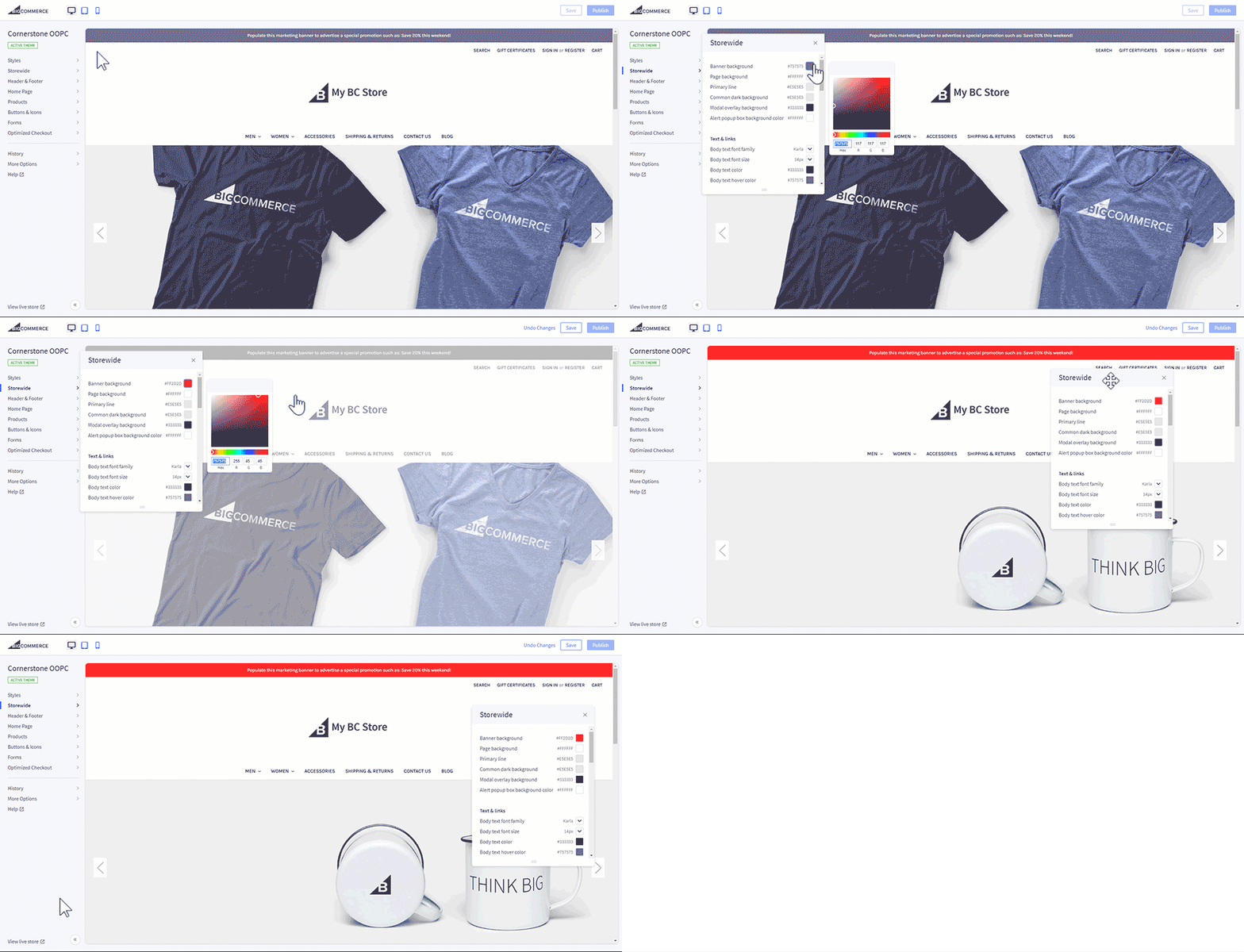
BigCommerce is a SaaS platform that allows SMBs to develop eCommerce sites. Features include the capabilities to design the storefront, configure products, manage payments, generate traffic, and optimize conversion.
$39
per month
Magento Open Source
Score 8.5 out of 10
N/A
Magento Open Source is an ecommerce content management solution originally developed by Varien Inc and presently supported by Adobe. The Open Source product is for developers and merchants that is available as a free download, and supported with free upgrades from the Magento Community.
N/A
Pricing
BigCommerce
Magento Open Source
Editions & Modules
Standard
$39
per month
Plus
$105
per month
Pro
$399
per month
Enterprise
Custom
per month
No answers on this topic
Offerings
Pricing Offerings
BigCommerce
Magento Open Source
Free Trial
Yes
No
Free/Freemium Version
No
No
Premium Consulting/Integration Services
No
No
Entry-level Setup Fee
No setup fee
No setup fee
Additional Details
A discount is offered for annual billing.
Pricing for Magento will vary greatly depending on outsourcing support and maintenance services.
Every criterion we evaluated against BigCommerce either won outright or held its own. What got us over the line was the incredible personal support at every step of the way from onboarding and implementation through to BAU. I had a support ticket this morning which I resolved …
Open source Magento was a full-time job. Now, I have a lot more freedom giving me the ability to take on more responsibilities and get my job done more efficiently. There were many headaches associated with Magento and depreciating version 1 and forcing users to migrate to …
BigCommerce is way better than 3dcart, it was comparable to Shopify but with the new product promotions available it is better than Shopify now. It is better than Magento in that you do not need dedicated programmers to make simple changes to your store!!! The best part about …
With BigCommerce you have great support (not with the open-source alternatives) without the high order fee that comes with Shopify. You also never have to worry about server settings or up-time. And you still have a lot of freedom with the design and functionality.
BigCommerce is a much more user friendly, manageable and cost-effective tool than Magento, which we previously used. We struggled to find a decent Magento developer and it was an extremely expensive platform which we didn't really need. Shopify for us was limited with our …
WooCommmerce and Magento are great, provided you have a consistent developer team that can constantly manage it and clients have the budget for that. But most times, the amount of money spent on developer managed sites is better spent on growing the company instead of custom …
Shopify: BigCommerce has more features at the price point we need. 1ShoppingCart: BigCommerce is far more versatile and can sustain our business for a greater amount of growth than 1ShoppingCart. Magento: While Magento was attractive for its customization, it would have required …
BigCommerce is a great and powerful platform that has lots of upside. We still have a couple basic sites running on BigCommerce, mainly for backing up customer and order data. At this time, we have moved most of our businesses over to Shopify Plus b/c we feel that we get much …
BigCommerce is a dream compared to Magento. Magento in not intuitive at all and nothing is where you think it should be! BigCommerce all day over here! I will say there are some functions I miss from Magento such as the ability to schedule promotions.
My business previously used Big Cartel which was perfect for a small artsy business. However when we grew, Big Cartel did not have all the functionality that we needed - such as subcategories and sub-subcategories. Wix was attractive but it felt a little like an instagram …
In Magento, you had to create a theme from scratch and they told me that would be 30K average to start which was way out of our budget. I really liked Shopify's site and features but they were twice the price when compared to BigCommerce and I didn't think the extra features …
BigCommerce is by far the easiest, most secure, and most worry-free of the competition. It falls a little short to Magento in the coupon code area, and Shopify has more out of the box gimmicks, but, in the end, they all fall short compared to BigCommerce.
Magento 1 was sunsetting so we initially looked to upgrade to Magento Cloud or Magento 2 Open Source. The conversion process was horrible and unable to be performed by our staff. The costs that developers quoted us were upwards of $100,000 PER SITE (we have 6!). This, of …
We started the business on Yahoo! Merchant 15 years ago. Yahoo! had a difficult to use proprietary language called RTML that I had to learn to be able to customize the pages. There were many things that I couldn't customize or couldn't access. I was really excited about the …
We were using Magento, our initial platform for several years. We switched to BigCommerce because they were a more robust platform and offered 24-hour customer service, which we did NOT have with Magento. We were always looking for a new IT company to help us with our updates …
I've also used Ultracart, Wix, and Square for shopping sites. Amoung the hosted platforms it's hands down my favorite. It's most similar to Shopify except that Bigcommerce has more native features, which is a good thing. With more native features there is less dependence from …
Shopify Plus simply lacks features that come out-of-the-box with BigCommerce. Their app store is impressive, but it feels like they need it so their customers can get all the features included with BC. Magento is extremely powerful, but it lacks all the conveniences that come …
Initially, we thought that it was going to be cost effective but now I regret my opinion. Shopify is more cost-effective than BigCommerce because Shopify doesn't have a sales threshold and you don't pay more if you surpass the sales threshold.
BigCommerce makes much for sense for clients looking to use an eCommerce system but not require a developer in house. BigCommerce offers the perfect combination of customization without being too much and requiring the knowledge of code to make changes. Albeit, Magento does …
Magneto Open Source allowed for a lot of customizations, and it seemed like a cheaper version. However, the cost added up really quickly. I would probably go with Shopify or BigCommerce for a small business when making decisions in the future.
I inherited the Magento Open Source website we are currently using, but after evaluating everything that was wanted for the new website, we switched over to Shopify. After using Shopify for some of our other websites, we learned that you have to pay a large sum each month to …
WooCommerce, when fully "plugged-in" required server resources which drowned our host. We hit a wall with growth due to these resources and researched redevelopment on Woo or migration to a new platform. We chose the latter. Shopify and BigCommerce were limited to their closed …
The three main reasons we went with Magento: 1. It was recommended by our NCR Counterpoint, VAR. 2. It's the best platform to integrate tightly with that NCR Counterpoint. It's also the best eventual platform to integrate with our wholesale ERP, so it's one platform to run …
Magento is the heaviest by far, in a few senses of the word. It has the steepest learning curve both for administrators and programmers, but it also has the highest potential to run a high traffic, high volume ecommerce store. Other products will get you up and running faster …
Magento is hands down better than any hosted platform (i.e., BC), but only if you have a good development team. Hosted platforms are very limiting as to what you can accomplish "outside the box." Magento is much better than WooCommerce in its user friendliness and its …
Compared to other small - medium sized business e-commerce solutions, Magento is by far requires the most development resources to implement and maintain. Creating a custom Drupal or WordPress based e-commerce solution requires development resources as well, but the complexity …
Magento CE stands up better than the other CMS systems in many regards. It is cheaper and easier to use than Drupal or Joomla! by a wide margin. It is more secure than any WordPress website, and unless you specifically need it, It does not store credit card information making …
The ONLY reason we left Volusion was fear that Volusion was going to go out of business and our website/data would all be lost. I feel BigCommerce is lightyears behind Volusion in website/inventory control. In our experience, BigCommerce customer service severely lacks knowledge, at least compared to what we had in our 7-1/2 years with Volusion. There were times Volusion even helped us with stuff BigCommerce could not understand. I just feel sick about moving and that should not be the case. In my opinion, I downgraded heavily for the feeling BigCommerce would not be going out of business. I just feel sick.
It's well suited for large eCommerce stores as it requires much effort to set up and the development cost for setting it up is high. It's less appropriate to use Magento where you are looking for quick development and launch of the store. Also, it is required to have a developer or sometimes the entire tech team to manage an e-commerce store, so you may need to hire a few PHP developers.
Magento 2 community is full of known and new bugs with long-pending pull requests and the community is on the hook for changes. Submit an very obvious issue to the github repo, and you will likely be met with a "this is open source and you use at your own risk." I counter this poor attitude with the fact that open source community has standards, and we do not label a "release" until those standards are met. Otherwise it's just a alpha, beta or numbered build. We don't release obviously bad software until it's fully working.
Magento is expensive to maintain. You will need a well-paid php developer with apache and hosting knowledge, or you will have to hire an external firm. Either option will turn your website into an additional $100k/yr cost center, so you'd better be ready to ramp up sales. Every feature update or bugfix in the past year has uncovered more bugs, which my devs fix, but at the cost of timelines and billed hours way outside of my budget and target dates.
BigCommerce is a great platform! It does the job and has a very good API set. I would definitely recommend it to others, but I would warn them about the cost associated with BigCommerce. There are lower cost solutions, but definitely not as feature rich as BigCommerce. It's definitely not perfect, and has a few wrinkles to iron, but nothing is ever perfect. It does the job for us and I do enjoy using the platform!!
It's the dominant force in the SMB open source market. With the continued support of eBay/PayPal, Magento will continue to evolve and should be a market leader for some time.
I think that overall it has a great front end for the customer. On the back end, it takes a little spin-up time, but in just a couple of hours you can really have your head wrapped around everything you're going to need 99% of the time. It takes me about 5 minutes to train a new user on how to interact with customer orders.
Magento has a relly step learning curve. This means that you need to find experienced developers who can lead junior ones, otherwise the overall development process can be a disaster. However, once you are comfortable in developing on the platform, the customization capability are basically limitless and you can adapt the platform to any use case you can imagine. Also, there are many alredy developed marketplace modules that can solve, out of the box, many problems you may face.
So far in my time with BigCommerce I have not had any down time when it comes to my webstore or accessing it at any time I need to. Knowing that they have such a good uptime, it makes me feel comfortable that my customers can access things anytime, but also keep sales going 24/7
I have not had any issues with pages loading slow or any real other issues, not that I have encountered so far. Speed of the site and images loading are fantastic and everything just seems to work nicely, which may seem like a simple thing to say about things, but when something just WORKS! Its rather nice vs fighting with things to work right.
Because they are always there no matter how simple or complex the question is, if they don't know the answer they don't fake it and just make you go away feeling frustrated.. they get you to someone that does know the answer. I always appreciate their help and their honesty!
They have a comprehensive online help file system that makes it easy to do almost anything. They cover just about everything you'd want to do with your online store with images, clear descriptions and in some cases video. I will, however, say the videos should be a little more professorially done and not sound like the employees are doing it in their cubical.
A certified BigCommerce design and solution partner will usually comprise a team of highly experienced designers, developers and marketers. It is our view that in the vast majority of cases, this will pay dividends in the long-term - especially for those teams that could use the extra support.
Big Commerce is definitely king in comparison to EvoX. Not only is Big commerce easier to use, it's also just a more powerful platform with many more capabilities (for example, EVOX has analytic capabilities but, nothing to the extent of Big Commerce's google analytics integration. EVOX's data is very base level and does not provide much customer insight besides visits/pages viewed.
Shopify is a closed ecosystem; the moment a client has a complex, custom workflow or needs to integrate with a legacy ERP system, Shopify’s app-based model falls short. WooCommerce just does not scale like Magento, and its architecture is not made for enterprise-scale e-commerce. SAP Commerce Cloud is a very close competitor, but it comes with licensing costs and sometimes can be overkill. It's, however, perfect if the customer already has something SAP in their ecosystem.
I believe after seeing all of the parts of this platform, one is able to develop the business and keep adding on select features for the business. There are multiple options for purchase with the various platforms once the business grows more. The different features being offered by the platform can lead us to scalability.
Provides a robust platform to sell a high-risk product.
Page Builder saves you time and money by negating the need to buy a template.
Includes robust promotion settings that allow for codes and automatic discounts, bulk discounts, and customer groups (i.e. military discount), all native options.
Better Total Cost of Ownership than bespoke e-commerce solutions due to being open source and the wide range of free/commercial extensions available to extend the platform.
Often more extensive to set up and maintain than other open source alternatives, such as WooCommerce.