
TrustRadius: an HG Insights company

HubSpot Marketing Hub

Score8.8 out of 10

2,198 Reviews and Ratings

What is HubSpot Marketing Hub?

HubSpot's Marketing Hub is an all-in-one inbound marketing engine that includes tools for email marketing, landing page creation, social media marketing, content management, reporting & analytics, search engine optimization (SEO), and more.

Media

Screenshot of Marketing Automation with HubSpot. Here, marketers can define workflows for highly targeted and personalized nurturing campaigns that send leads and prospects the right targeted content at the right point in their decision-making process.
Screenshot of HubSpot Analytics. These help track engagement with the entire funnel through real-time reporting on website performance, traffic and marketing effectiveness.
Screenshot of HubSpot Social Media. HubSpot’s social media publishing helps improve scheduling and publishing social media content.
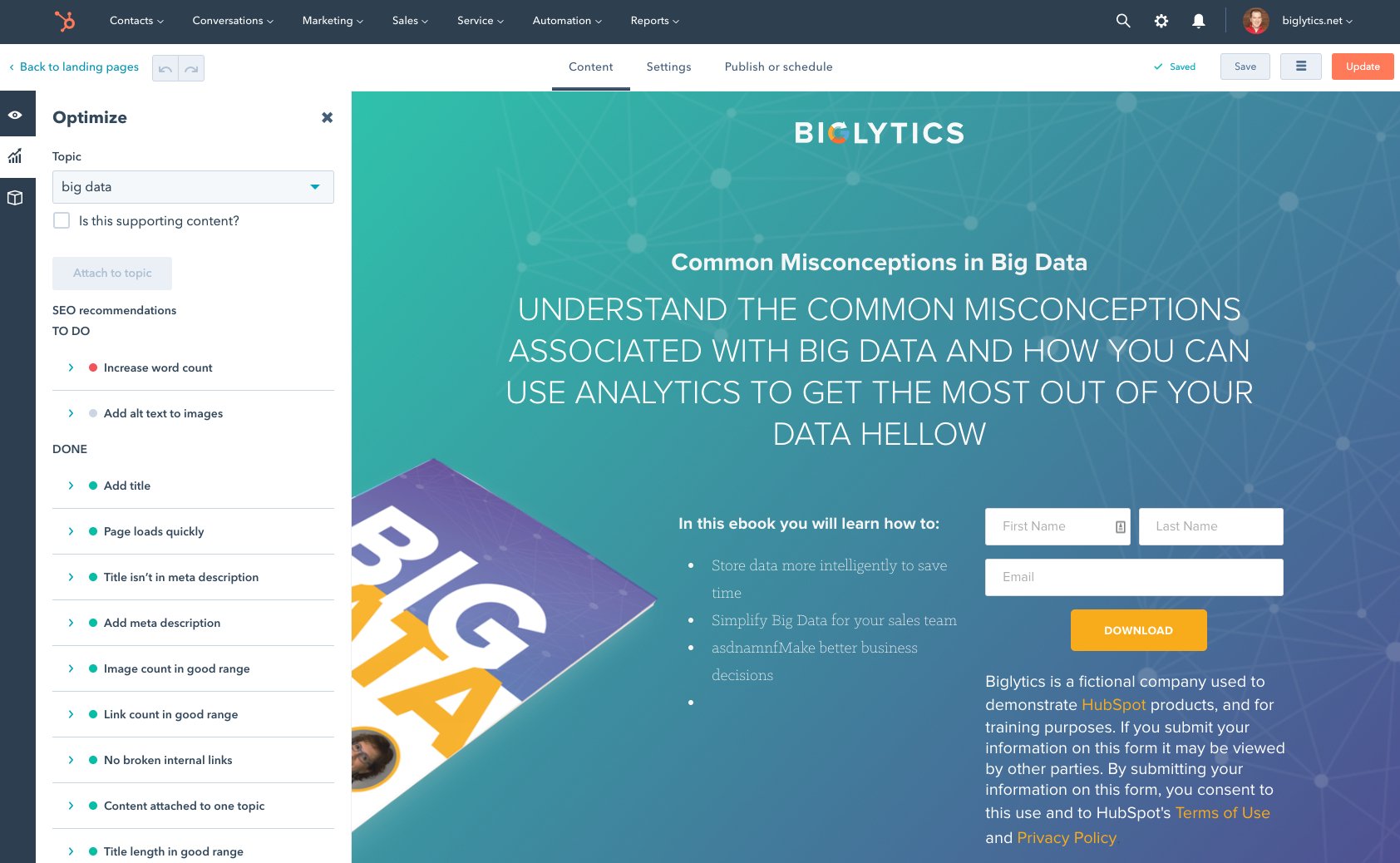
Screenshot of HubSpot Blogging and SEO. HubSpot provides an integrated set of tools for Search Engine Optimization (SEO) which makes getting found online a natural part of the inbound marketing mix. More than a simple CMS, HubSpot provides an integrated authoring view with SEO-oriented suggestions as blog posts are written.
Screenshot of Marketing Automation with HubSpot. Here, marketers can define workflows for highly targeted and personalized nurturing campaigns that send leads and prospects the right targeted content at the right point in their decision-making process.
Screenshot of HubSpot Contacts. Integrating with most common CRMs, HubSpot provides a view of view contacts, and allows for customized and personalized email communications.

1 / 6

Screenshot of Marketing Automation with HubSpot. Here, marketers can define workflows for highly targeted and personalized nurturing campaigns that send leads and prospects the right targeted content at the right point in their decision-making process.

Top Performing Features

  • List management

    This involves creating, filtering, editing, merging and de-duping lists of contacts.

    Category average: 8.5

  • Automated sales alerts and tasks

    The software helps ensure that a sales person is notified of lead activity and can act on the information in a timely fashion.

    Category average: 7.8

  • Social profile integration

    The software incorporates social profile data and social share histories to enhance segmentation and scoring of contacts.

    Category average: 8.2

Areas for Improvement

  • Calendaring

    The software helps users maintain a calendar of all marketing activities.

    Category average: 7.5

  • Event/webinar marketing

    Users can streamline event marketing with features such as personalized invitations, registration, reminders and post-event follow-ups.

    Category average: 8

  • A/B testing

    Users can experiment with different variations of a campaign and measure results. Testable aspects might include subject lines, header images, or landing page copy.

    Category average: 7.9

The All-in-One Solution for Streamlined Marketing and Seamless Integrations

Use Cases and Deployment Scope

I think HubSpot Marketing Hub helps with streamline lead generation through its forms, landing pages, and lead capture tools. It also integrates with various sources like social media, email, and website traffic it solves the problems of disjointed marketing processes.

Pros

  • Marketing Automation
  • Email Marketing

Cons

  • Pricing Structure and Costs
  • Email Marketing Limitations

Return on Investment

  • Lead Nurturing & Automation
  • Time Savings
  • Cost vs. Benefit

Usability

Alternatives Considered

Intuit Mailchimp and GetResponse

Other Software Used

Zapier, Informatica Customer 360 for Salesforce, Typeform
The Only Platform for Marketing if you want to Grow

Use Cases and Deployment Scope

At Salted Stone, HubSpot enables us to create highly targeted lead generation campaigns using landing pages, forms, and CTAs which has been a keen element of driving growth and revenue. Through CRM integration, we bridge gap between our marketing and sales teams, ensuring seamless lead handoffs and improved revenue attribution. Personalisation is critical today in getting our message to market and as such, we use dynamic content, smart CTAs, and email personalisation in HubSpot to enhance customer interactions and make every touchpoint feel relevant.

Pros

  • Lifecycle stage tracking which allows our teams to tailor communication and engagement based on where a contact is at any point of the Buyer Journey
  • Data is king! HubSpot's automated A/B testing and analytics help us optimise email campaigns and landing pages for higher engagement.
  • We know what is working and what is not - attribution reporting ensures we can track ROI and make data-backed marketing decisions in real-time

Cons

  • Social Media Management – although you can schedule and manage social posts there are more advanced AI platforms that add intel and insights.
  • Removing landing pages from Marketing Hub and putting them in the new Content Hub has been a challenge as you need assets for all campaigns you run
  • Enterprise v Professional level Marketing Hub is a big price jump but the added features and benefits don't align

Return on Investment

  • A Manufacturing client saw leads grow by 35.71%, and a 47.85% increase in qualified Opportunities using HubSpot Marketing Hub
  • Inbound leads added a 20% increase for a client in the B2C space, a leading Insurance brand, delivering more engaged and qualified leads.
  • Another client, a remote Teams Business better qualified leads, grew deals won and saw a 20% increase in monthly revenue.

Usability

Alternatives Considered

Salesforce Marketing Cloud, Adobe Marketo Engage and Microsoft Dynamics 365

Other Software Used

Adobe Acrobat, Figma, Slack

The best Marketing CRM

Use Cases and Deployment Scope

We use HubSpot Marketing Hub to facilitate the majority of our Marketing activities. We use it for our CRM, for emails, landing pages, as a content hub, for automated workflows, and for our reporting. It is connected to our SalesForce instance for more in-depth Marketing reporting. We were looking for a one-stop shop tool that was intuitive and easy to use. By having all of our Marketing data in one place, we are better able to track our impact and ROI.

Pros

  • Reporting / Dashboards: It is easy to set up different reports to track impact. The platform surfaces relevant way that is easy to understand and actionable.
  • Workflows: Workflows are easy to set up and edit on the fly. A specific use case we love is that you can create email nurture programs, set them live, and then edit the workflow without pausing it (i.e. if all of your content is not ready at the same time).
  • Email and Landing Page Creation: Editing and creating emails and landing pages with drag and drop functionality.

Cons

  • Influenced and Sourced Pipeline reports could be easier to set up
  • Creation of "calculators" for landing pages (i.e. showing a prospect the ROI of using our product after then input information into a few fields)

Return on Investment

  • We went from not being able to track Marketing impact to being able to attribute 40% of our pipeline to Marketing sourced activities
  • We went from primarily using events as our main source of new pipeline to being able to track engagement from email marketing, content downloads, and social media

Usability

Alternatives Considered

Salesforce Marketing Cloud

Other Software Used

Figma, Canva, monday.com

HubSpot Marketing Hub Review

Use Cases and Deployment Scope

We use HubSpot Marketing Hub to maintain all our marketing campaigns and sales tasks under one roof. From running a marketing campaign and automating it to nurturing leads through email marketing, everything in the realm of sales and marketing fields can be managed here. The prime problem this tool solves is the scattered workflow. Before HubSpot, our organisation struggled with juggling multiple platforms to tackle multiple tasks, but now everything can be completed more efficiently and effectively.

Pros

  • Personalised email management - It is super easy to create custom emails based on user actions which allows us to personalise our email marketing strategy
  • CRM Integration - This feature allows us to maintain a good alignment with both marketing and sales aspect of the organisation
  • Landing page builder - It is very easy to create a professional looking landing page with the drag and drop feature

Cons

  • Price - While some features are free to use, some of them needs premium subscriptions which can be expensive for small to medium organizations
  • Limited customization - The options of customization are good at a basic level but if we need something more complex there are no options to customize our layouts or designs
  • Learning curve - With numerous features, this platform might be overwhelming to a beginner. So, one might need to spend a good time learning how to use the features in this platform.

Return on Investment

  • Since switching to HubSpot, our organisation has seen 15% improvement in conversion rates
  • It helped in streamling our workflows and increased producitvity by eliminating unecessary errors
  • We struggled with the learning curve a bit initially, especially with the automation features

Usability

Alternatives Considered

Intuit Mailchimp and Zoho CRM

Other Software Used

Google Analytics, Trello, Notion, Canva